
Filtering by: History of the Present
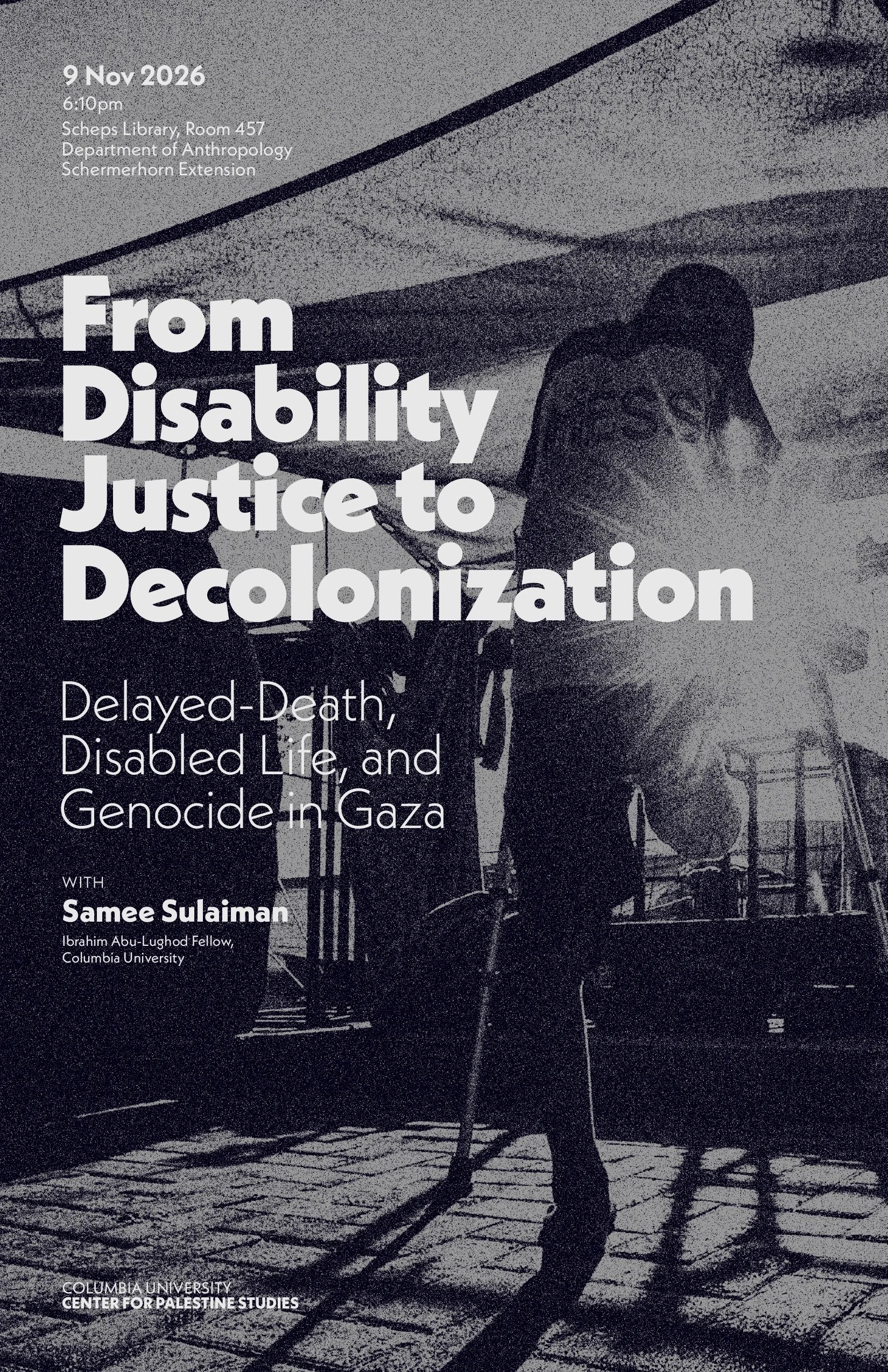
From Disability Justice to Decolonization: Delayed-Death, Disabled Life, and Genocide in Gaza
Nov
9
6:10 PM18:10

From Disability Justice to Decolonization: Delayed-Death, Disabled Life, and Genocide in Gaza

Join the Center for Palestine Studies for a talk by Samee Sulaiman,
Ibrahim Abu-Lughod Fellow, Columbia University.


VENUE
Scheps Library, Room 457,
Department of Anthropology
Schermerhorn Extension

Advanced registration by Thursday, November 5,
is required for all attendees, including CU/BC ID holders.


This paper examines mass disablement in Gaza as a central technology of colonial elimination and genocide. Developing the concept of “death-by-disablement,” it traces how bombardment, siege, forced displacement, and the systematic destruction of healthcare and life-sustaining infrastructure produce debility and turn survivable injuries into pathways toward premature death. Drawing on Palestinian testimony, disability justice scholarship, and reports documenting the assault on Gaza, the paper argues that disability cannot be understood solely as an outcome of war. It is also a condition deliberately produced and intensified through the deprivation of care. Ultimately, this paper argues that disability justice in Palestine cannot be achieved through humanitarian aid, medical rehabilitation, or reconstruction alone; it requires decolonization and the dismantling of the political conditions that continually produce mass injury, debility, and death.

Samee Sulaiman is an anthropologist whose research and teaching focus on disability, political violence, mobility, and social movements in Lebanon and Palestine. He received his PhD in Anthropology from Brown University in 2023 and was previously a Postdoctoral Research Associate in Palestine Studies at Yale University’s Council on Middle East Studies. His research draws on ethnographic work with Lebanese and Palestinian disability activists and organizations, examining disability politics, citizenship and non-citizenship, war, and crisis in Lebanon. His current work focuses on disability and mass disablement in Palestine, particularly in Gaza, and explores the relationship between disability justice, decolonization, reconstruction, and liberation. He is currently the Ibrahim Abu-Lughod Postdoctoral Fellow at Columbia University’s Center for Palestine Studies. Learn more about his work here.
View Event →

No Land to Stand On
Oct
27
6:10 PM18:10

No Land to Stand On

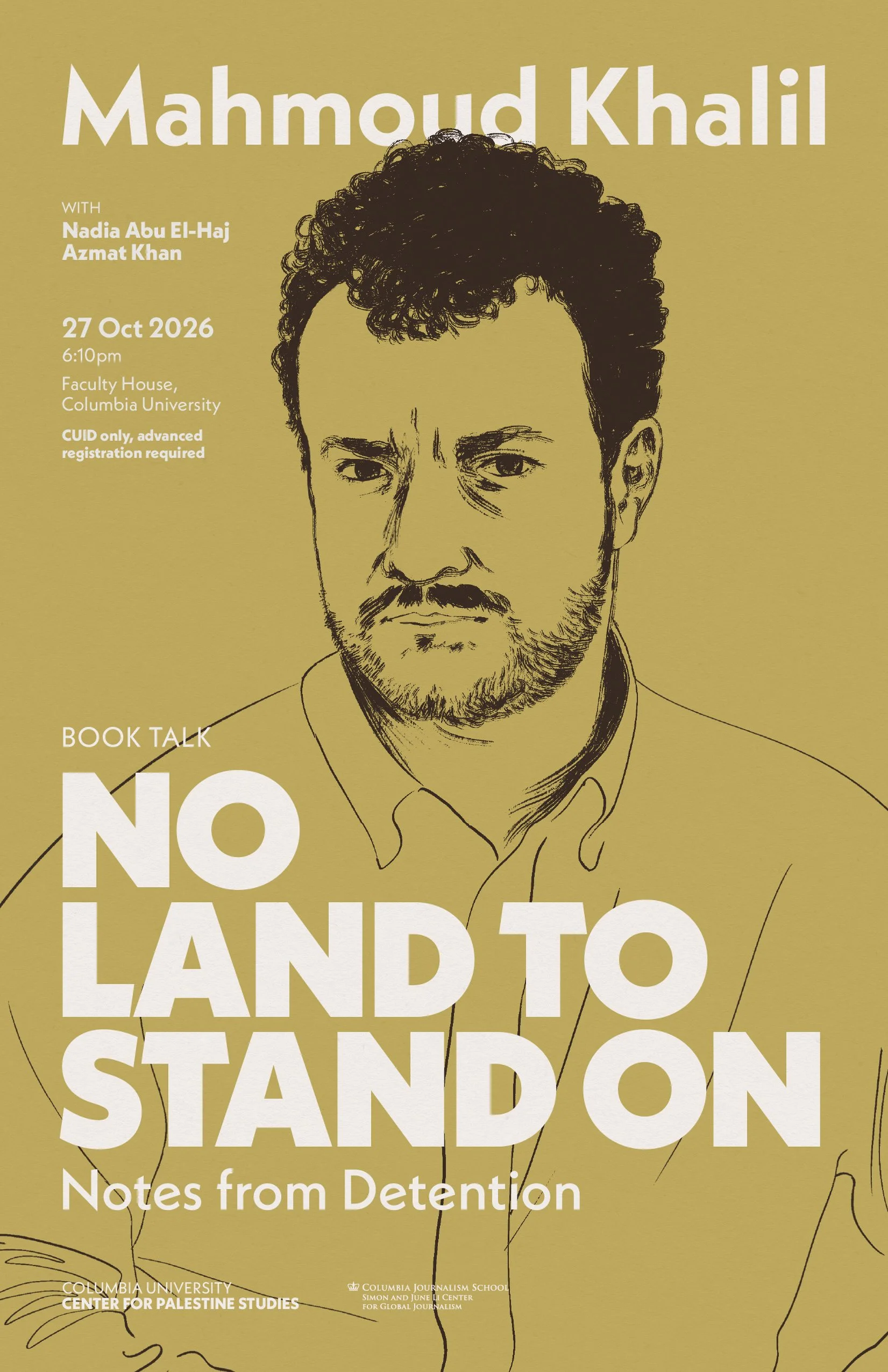
Join the Center for Palestine Studies and the Simon and June Li Center for Global Journalism for an evening with MAHMOUD KHALIL in conversation with NADIA ABU EL-HAJ. Introduction by AZMAT KHAN.

A revelatory and powerful testament of protest, courage, and imprisonment in America’s deportation regime

This event is only open to CUID holders and advanced registration is required for all attendees.
Registration does not guarantee a seat, so please plan accordingly.

———

“Are you Mahmoud Khalil?” The question marked the start of a politically charged odyssey that took the Palestinian graduate student and legal resident from his pregnant wife and home in New York City, transported him across the country, and locked him up in a Louisiana detention camp under threat of deportation. His “crime”: exercising his right to free speech at Columbia University, where he emerged as a leading voice against the slaughter of Palestinians in Gaza. No Land to Stand On is his indelible account, the story of a man confronting the reality that he had become target number one for a lawless regime shredding basic rights.

Drawing on his prison diary and writing in vivid, page-turning detail, Mahmoud Khalil conjures the despair and cruelty of ICE detention, where prisoners can vanish overnight and visiting families risk their own deportation. There is humanity, too, in the men’s acts of care—their mutual help with documents, the prison cake they make after Mahmoud can only follow the birth of his son on the public payphone. In tandem, he tells the multi-generational story of a family expelled from Palestine to a Syrian refugee camp, of flight from Assad’s regime to Lebanon, of arrival in an America that promised permanence and protection, and of the enduring struggle for Palestine.

A work of courage and resistance, No Land to Stand On is a call to integrity, to staying true to one’s life’s mission, and to defending the inalienable right to safety, freedom, and a land to stand on.

———

MAHMOUD KHALIL is a Palestinian born in a refugee camp in Syria. He fled Assad’s Syria at the age of 18 and holds Algerian citizenship. He studied computer science at the Lebanese American University while working with Syrian refugees in Lebanon, then served as programs manager at the British Embassy in Beirut. He moved to the United States in 2022 to attend Columbia University’s School of International and Public Affairs, where he became a prominent figure during the student protests against the war on Gaza. Mahmoud lives in New York, where he continues to fight against the threat of deportation. No Land to Stand On is his first book.

NADIA ABU EL-HAJ is Barbara Chamberlain and Helen Chamberlain Josefsberg '30 Professor in the Departments of Anthropology at Barnard College and Columbia University and Co-Director of the Center for Palestine Studies at Columbia University. 

AZMAT KHAN is a Pulitzer-winning investigative reporter whose work exposes the true human costs of wars waged or supported by the United States. She is the Patty Cadby Birch Assistant Professor at Columbia Journalism School, where she leads the Simon and June Li Center for Global Journalism. She received the 2022 Pulitzer Prize in International Reporting for “The Civilian Casualty Files,” based on five years of fieldwork in Iraq, Syria, and Afghanistan and a legal fight for military records.

———

Light refreshments will be served.

The event will be followed by a book signing, with copies of No Land to Stand On available for purchase.

———

This event is only open to CUID holders and advanced registration is required for all attendees. Registration does not guarantee a seat, so please plan accordingly.

Please note that no outside food or drink will be permitted and that bags must be checked at the door. Coat check will be available.

———

Presented by the Center for Palestine Studies and the Simon and June Li Center for Global Journalism.

View Event →
Here Where We Live Is Our Country: Molly Crabapple in Conversation with Rashid Khalidi
Oct
12
6:00 PM18:00

Here Where We Live Is Our Country: Molly Crabapple in Conversation with Rashid Khalidi

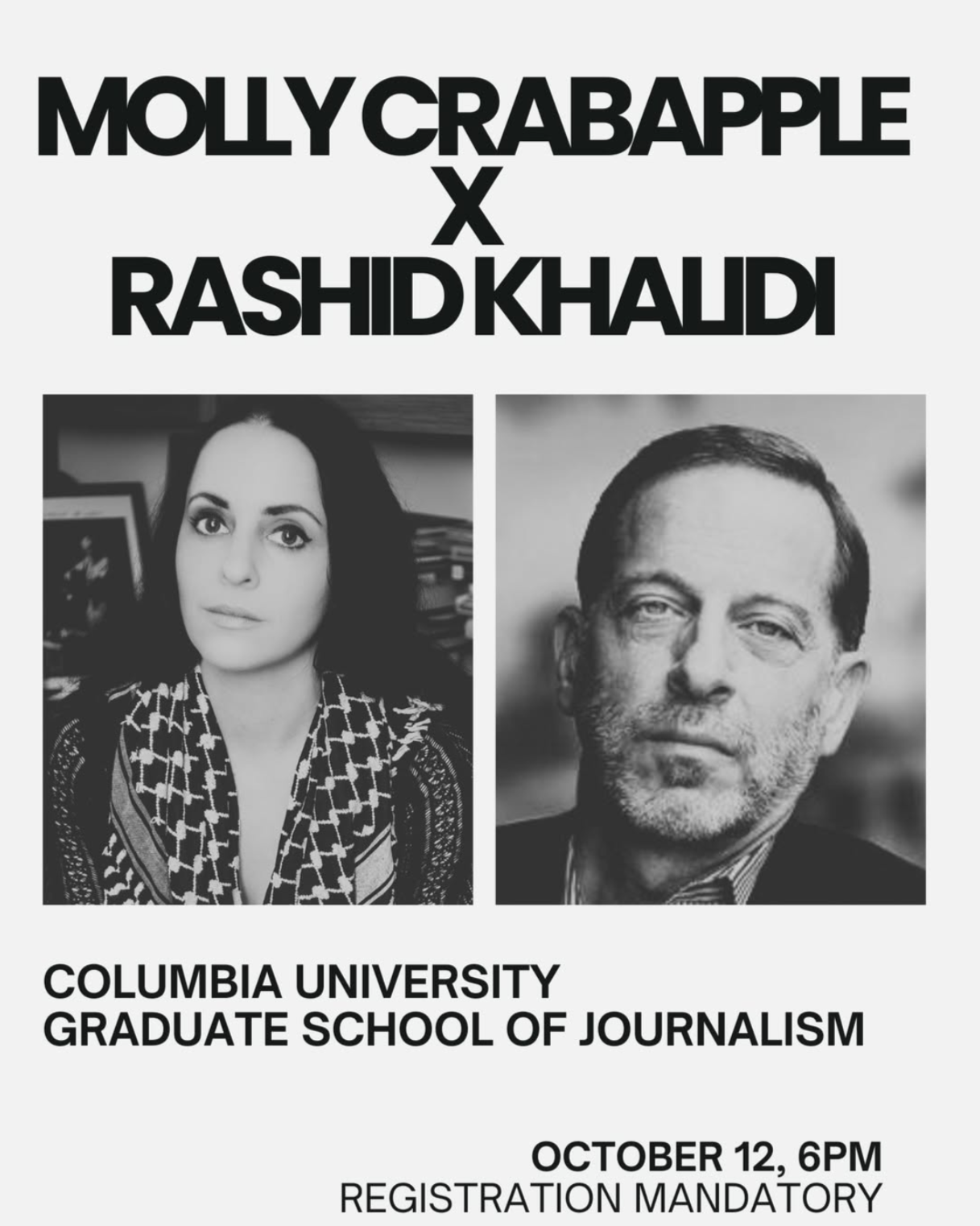
Join the Simon and June Li Center for Global Journalism, the Center for Palestine Studies, and the Committee on Global Thought for a discussion with Molly Crabapple and Rashid Khalidi about Crabapple’s new book Here Where We Live Is Our Country: The Story of the Jewish Bund.

VENUE
Columbia Journalism School
Pulitzer Hall, Lecture Hall, 3rd Floor
2950 Broadway
New York, NY 10027

Advanced registration is required for all attendees, including CU/BC ID holders.

"Vast in scope, elegiac in prose, Here Where We Live Is Our Country brings to life the profound humanity of those who stood up to the blood-soaked ethnonationalisms that led to so many of the twentieth century’s storied horrors." — Jason Stanley, New York Times bestselling author of How Fascism Works

"Here Where We Live Is Our Country is that rarest of books: a gripping, human story of love, idealism, and betrayal—and an immense, rigorous contribution to the historical record. Reading it feels revolutionary.” — Naomi Klein, New York Times bestselling author of No Logo and Doppeleganger

In the aftermath of the Holocaust, Sam Rothbort created “memory paintings” with the hope of resurrecting the vanished world of his shtetl childhood. Decades later, his great-granddaughter, the award-winning artist Molly Crabapple, discovered these paintings and one stood out: a girl, her dress the color of sky, hurling a rock through a cottage window. Itka the Bundist, Breaking Windows.

Itka is how Crabapple met the Jewish Labor Bund. Once the most influential Jewish political force in eastern Europe, the Bund was secular, socialist, and uncompromisingly anti-Zionist. The Bundists fought for dignity and equality, not in an imagined homeland in Palestine but “here where we live.”

In the first popular history of the Bund, Crabapple re-creates their extraordinary world through dramatic portraits of insurgent poets and antireligious rebels, clandestine revolutionaries and lovers on the barricades. The Bundists live deeply within this violent, volatile, and somehow hopeful period, as their stories interweave with the Russian Revolution and the Holocaust. The Bund’s rise and fall raises the vital question: What can we learn from a movement that, for all its toughness, imagination, and moral clarity, was largely destroyed?

Here Where We Live Is Our Country reanimates a band of idealists who broadened our global political imagination. As we once again contend with nationalism, repression, and the struggle for belonging, the Bund’s remarkable story and message—that liberation, dignity, and solidarity must begin where we stand—reaches across time as a guide to our own urgent moment.

Copies of Here Where We Live Is Our Country will be available for purchase.

This event is sponsored by the Simon and June Li Center for Global Journalism, the Center for Palestine Studies, and the Committee on Global Thought at Columbia University.

View Event →