
Filtering by: Palestine Library
No Land to Stand On
Oct
27
6:10 PM18:10

No Land to Stand On

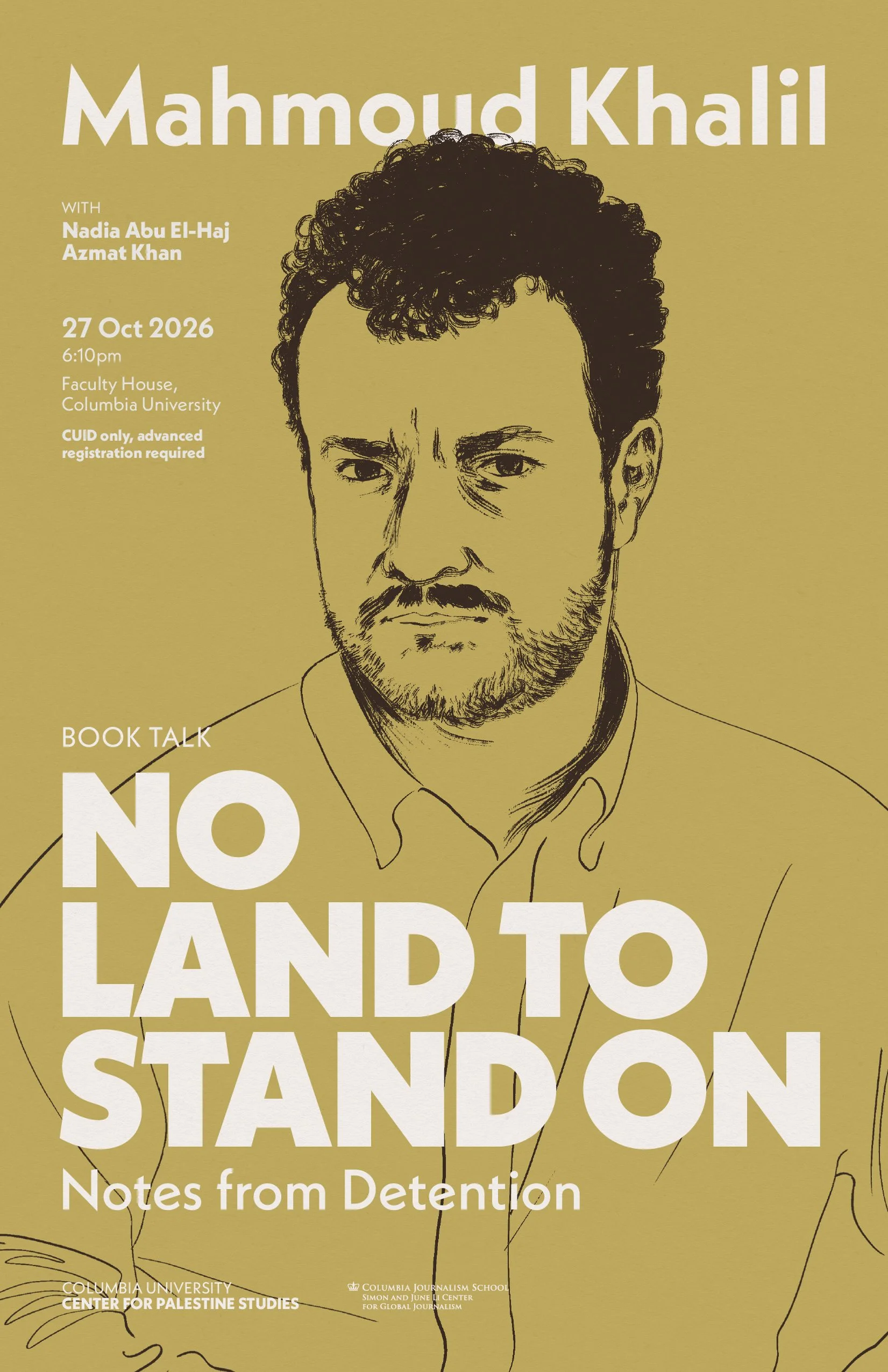
Join the Center for Palestine Studies and the Simon and June Li Center for Global Journalism for an evening with MAHMOUD KHALIL in conversation with NADIA ABU EL-HAJ. Introduction by AZMAT KHAN.

A revelatory and powerful testament of protest, courage, and imprisonment in America’s deportation regime

This event is only open to CUID holders and advanced registration is required for all attendees.
Registration does not guarantee a seat, so please plan accordingly.

———

“Are you Mahmoud Khalil?” The question marked the start of a politically charged odyssey that took the Palestinian graduate student and legal resident from his pregnant wife and home in New York City, transported him across the country, and locked him up in a Louisiana detention camp under threat of deportation. His “crime”: exercising his right to free speech at Columbia University, where he emerged as a leading voice against the slaughter of Palestinians in Gaza. No Land to Stand On is his indelible account, the story of a man confronting the reality that he had become target number one for a lawless regime shredding basic rights.

Drawing on his prison diary and writing in vivid, page-turning detail, Mahmoud Khalil conjures the despair and cruelty of ICE detention, where prisoners can vanish overnight and visiting families risk their own deportation. There is humanity, too, in the men’s acts of care—their mutual help with documents, the prison cake they make after Mahmoud can only follow the birth of his son on the public payphone. In tandem, he tells the multi-generational story of a family expelled from Palestine to a Syrian refugee camp, of flight from Assad’s regime to Lebanon, of arrival in an America that promised permanence and protection, and of the enduring struggle for Palestine.

A work of courage and resistance, No Land to Stand On is a call to integrity, to staying true to one’s life’s mission, and to defending the inalienable right to safety, freedom, and a land to stand on.

———

MAHMOUD KHALIL is a Palestinian born in a refugee camp in Syria. He fled Assad’s Syria at the age of 18 and holds Algerian citizenship. He studied computer science at the Lebanese American University while working with Syrian refugees in Lebanon, then served as programs manager at the British Embassy in Beirut. He moved to the United States in 2022 to attend Columbia University’s School of International and Public Affairs, where he became a prominent figure during the student protests against the war on Gaza. Mahmoud lives in New York, where he continues to fight against the threat of deportation. No Land to Stand On is his first book.

NADIA ABU EL-HAJ is Barbara Chamberlain and Helen Chamberlain Josefsberg '30 Professor in the Departments of Anthropology at Barnard College and Columbia University and Co-Director of the Center for Palestine Studies at Columbia University. 

AZMAT KHAN is a Pulitzer-winning investigative reporter whose work exposes the true human costs of wars waged or supported by the United States. She is the Patty Cadby Birch Assistant Professor at Columbia Journalism School, where she leads the Simon and June Li Center for Global Journalism. She received the 2022 Pulitzer Prize in International Reporting for “The Civilian Casualty Files,” based on five years of fieldwork in Iraq, Syria, and Afghanistan and a legal fight for military records.

———

Light refreshments will be served.

The event will be followed by a book signing, with copies of No Land to Stand On available for purchase.

———

This event is only open to CUID holders and advanced registration is required for all attendees. Registration does not guarantee a seat, so please plan accordingly.

Please note that no outside food or drink will be permitted and that bags must be checked at the door. Coat check will be available.

———

Presented by the Center for Palestine Studies and the Simon and June Li Center for Global Journalism.
View Event →
Ghassan Kanafani's Palestinian Resistance Literature Under Occupation, 1948-1968
Nov
12
6:10 PM18:10

Ghassan Kanafani's Palestinian Resistance Literature Under Occupation, 1948-1968

VENUE
807 Schermerhorn Hall

Advanced registration by 5pm, Tuesday, November 10, is required for all attendees, including CU/BC ID holders.

RASHID KHALIDI in conversation with ISABELLA HAMMAD about Ghassan Kanafani's Palestinian Resistance Literature Under Occupation, 1948-1968.

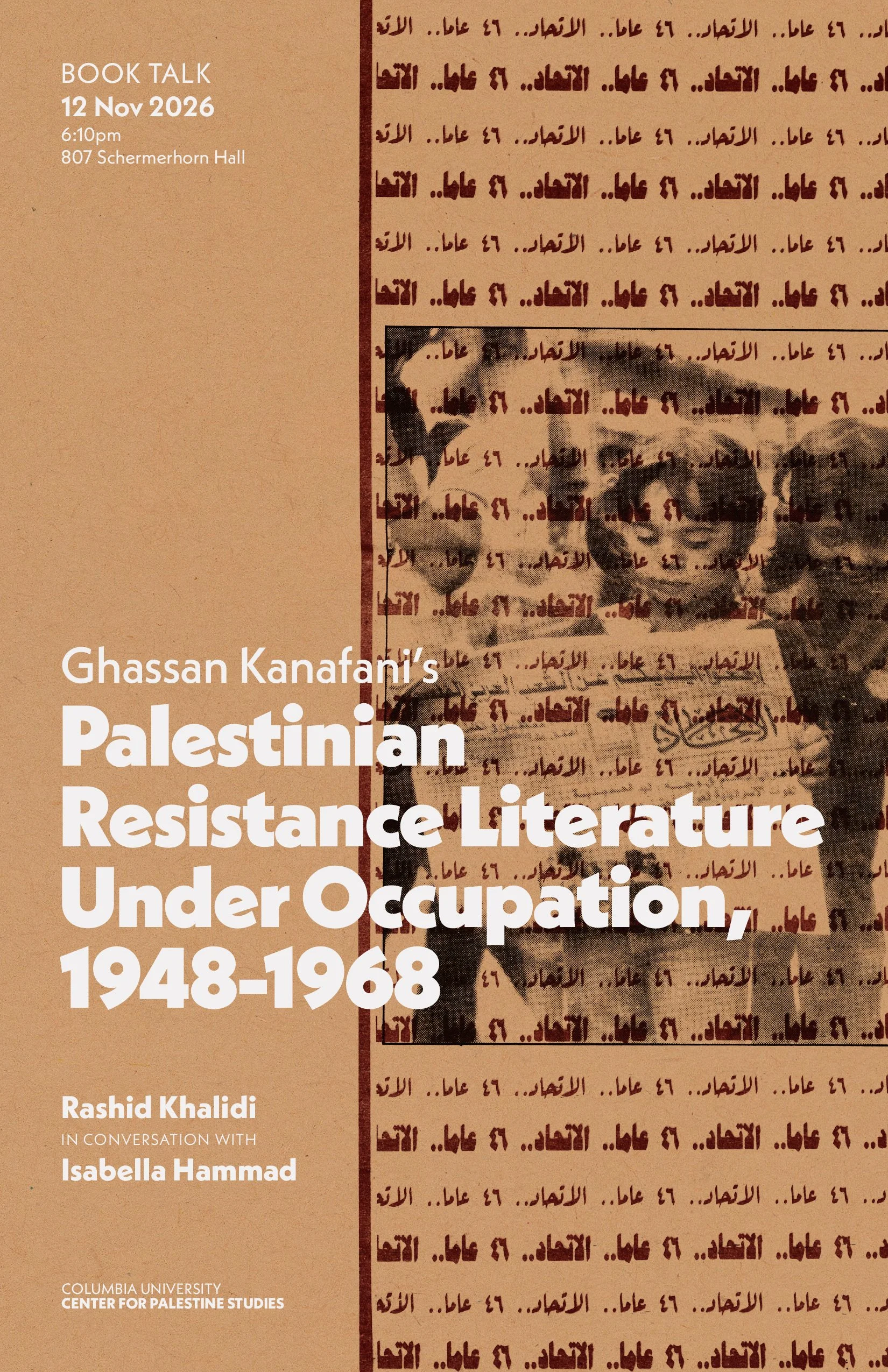
Ghassan Kanafani’s remarkable extended essay Palestinian Resistance Literature Under Occupation, 1948–1968 is an unyielding act of cultural and political endurance. Writing in the wake of Israel’s devastating territorial expansion in 1967, Kanafani elaborates his theory of resistance literature and offers a visceral account of life under occupation. Translated for the first time into English by one of the greatest living translators from Arabic to English, Tarif Khalidi, Kanafani’s essay offers one of the sharpest social and political analyses of life in Palestine in this early period of occupation.

In the two decades following the Nakba, Palestinian writers undertook the gruelling task of advancing a cultural struggle to protect their language, culture, and heritage. In addition to Kanafani’s groundbreaking essay, the book includes a selection of poetry, prose, and dramatic writing curated by Ghassan Kanafani himself. Alongside writing from Mahmoud Darwish, Hanna Abu Hanna, and Samih al-Qasim, among many others, Kanafani’s essay and the accompanying pieces stand as a defiant declaration of cultural survival in the wake of Israeli expansion.

This first English edition of Palestinian Resistance Literature Under Occupation is a joint publication with the Institute for Palestine Studies.

Copies of Palestinian Resistance Literature Under Occupation will be available for purchase at the event.

RASHID KHALIDI is Edward Said Professor Emeritus of Modern Arab Studies at Columbia University and the author of numerous books and articles, including The Hundred Years' War on Palestine (2020), a landmark history of one hundred years of war waged against the Palestinians from the foremost US historian of the Middle East, told through pivotal events and family history.

ISABELLA HAMMAD is a novelist and Writer in Residence at NYU. Her debut novel The Parisian (2019), won a Palestine Book Award, the Sue Kaufman Prize from the American Academy of Arts and Letters, and a Betty Trask Award. Her second novel Enter Ghost (2023) received the Encore Award and the Aspen Words Literary Prize. Her book-length essay Recognizing the Stranger (2024), was longlisted for the 2024 NBCC Award for Criticism.

View Event →

Edward Said: The Politics of an Oppositional Intellectual: An Evening with Nubar Hovsepian
Oct
6
6:10 PM18:10

Edward Said: The Politics of an Oppositional Intellectual: An Evening with Nubar Hovsepian

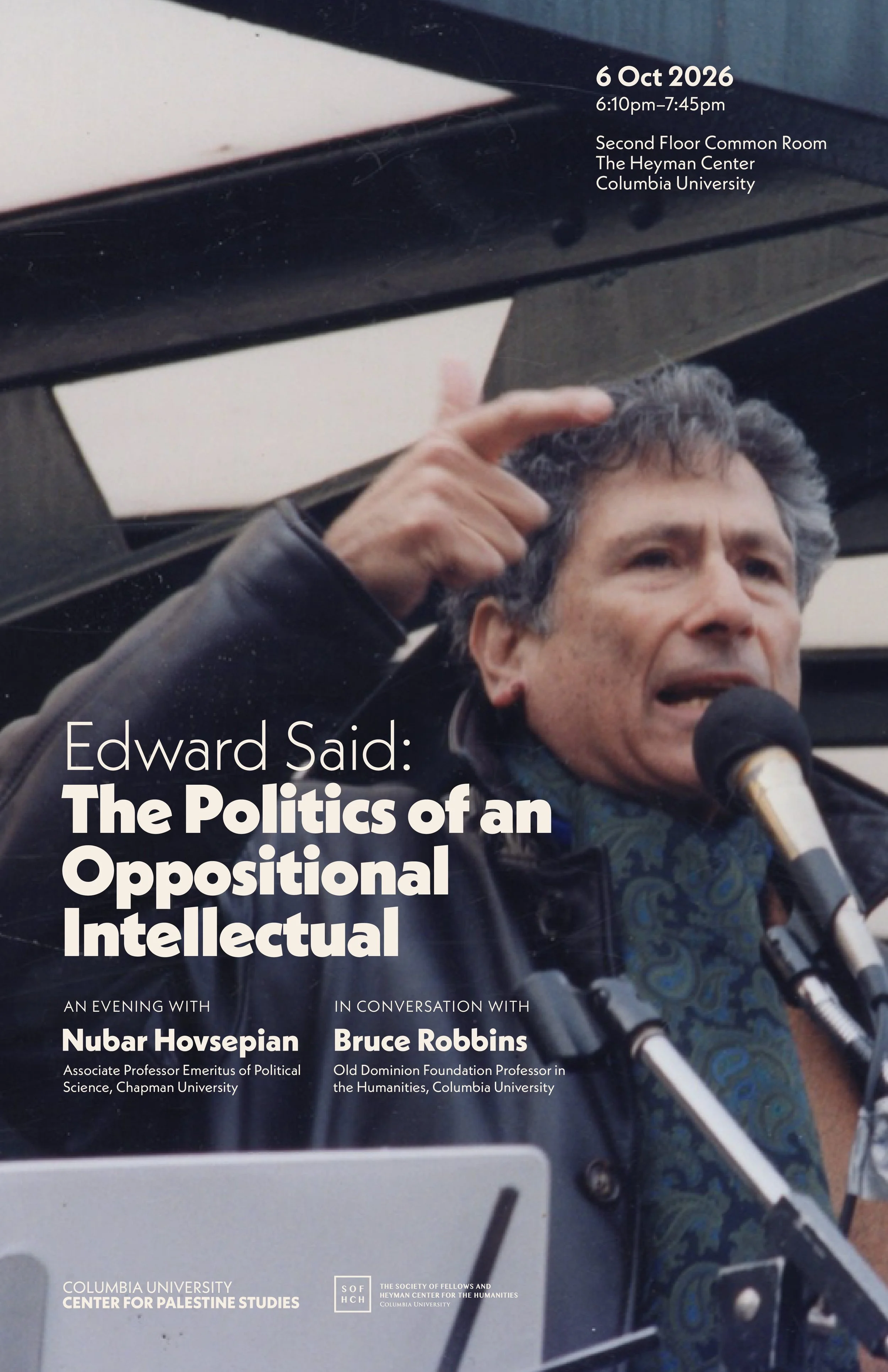
Nubar Hovsepian’s new book, “Edward Said: The Politics of an Oppositional Intellectual,” deals with a simple question: How does Said’s Humanism inform his politics, on Palestine, the Middle East and US policies? Nubar Hovsepian will read excerpts from his book and be joined in conversation by Bruce Robbins.

VENUE
Second Floor Common Room
The Heyman Center
Columbia University
Click here for a map


Advanced registration is required for all attendees, including CUID holders.


Nubar Hovsepian
is Associate Professor Emeritus of Political Science, Chapman University. He is the author of Edward W. Said: The Politics of an Oppositional Intellectual (2025) and Palestinian State Formation: Education and the Construction of National Identity (Cambridge Scholars Publishing, 2009) and he edited and contributed to The War on Lebanon (Interlink Publishers, 2008).  He has also written and edited four books in Arabic, most notably on the Iranian revolution of 1979, and has published articles in professional journals, newspapers, and magazines in various parts of the world. Hovsepian has devoted enormous time to the Israel/Palestine conflict, and served, from 1982 to 1984, as Political Affairs Officer for the United Nations Conference on the Question of Palestine.

Bruce Robbins is Old Dominion Foundation Professor in the Humanities, Columbia University. His most recent books are Who's Allowed to Protest? (Melville House, 2026) and Teaching Politically (Fordham, 2025), coedited with May Hawas. Atrocity: A Literary History (Stanford, 2025), won the Wellek Prize for the best monograph in Comparative Literature. He is also the author of Criticism and Politics: A Polemical Introduction (Stanford, 2022), The Beneficiary (Duke, 2017), and Cosmopolitanisms, co-edited with Paulo Horta (NYU, 2017).  His essays have appeared in The Baffler, n+1, The Nation, The New Statesman, Public Books, the London Review of Books, and the LA Review of Books. His efforts on behalf of justice for Palestine began in 2002, when he collaborated (with the physicist Alan Sokal) on an "Open Letter of American Jews to Our Government" that called for cutting off American aid to Israel if Israel refused to recognize the relevant United Nations resolutions.  The "Open Letter" was published in the New York Times with over 4000 signatures and translated into various languages.  He is the director of two documentaries, “Some of My Best Friends Are Zionists” and “What Kind of Jew Is Shlomo Sand?” His book Why Read Said Now? is forthcoming from Polity in 2027.


Organzed by the Center for Palestine Studies
& co-sponsored by The Society of Fellows and Heyman Center for the Humanities.


“Edward Said, the well-known Palestinian American intellectual, did not set out to be a partisan provocateur; if, more than two decades after his death, his work is treated as though he had been merely an ideologue or simply a shill for the Palestine Liberation Organization, it is a testament to the deeply debased quality of today’s debate about the Middle East rather than a reflection of his scholarship and public writing. Hovsepian, a U.S.-based academic, was Said’s friend, admirer, confidant, and sometime sparring partner. Drawing on his own diaries and Said’s unpublished letters and manuscripts, Hovsepian sketches both the portrait of a friendship and an intellectual biography. From Said’s early focus on music and English literature to his political awakening in the aftermath of the 1967 Six-Day War, Hovsepian traces Said’s evolving arguments about the relationship between culture and politics, best exemplified in Orientalism, Said’s most influential work, and his shifting conceptions of humanism and nationalism. As Said turned his skills as a literary critic to political analysis, he understood it as the responsibility of an intellectual to test conventional wisdom and challenge the complacency of the powerful, including the PLO, the U.S. government, and those he considered their apologists. This book is a useful reminder of the value of such critical perspectives.” 

Lisa Anderson, Foreign Affiars 

View Event →