From Disability Justice to Decolonization: Delayed-Death, Disabled Life, and Genocide in Gaza
Nov
9
6:10 PM18:10

From Disability Justice to Decolonization: Delayed-Death, Disabled Life, and Genocide in Gaza

Join the Center for Palestine Studies for a talk by Samee Sulaiman,
Ibrahim Abu-Lughod Fellow, Columbia University.


VENUE
Scheps Library, Room 457,
Department of Anthropology
Schermerhorn Extension

Advanced registration by Thursday, November 5,
is required for all attendees, including CU/BC ID holders.


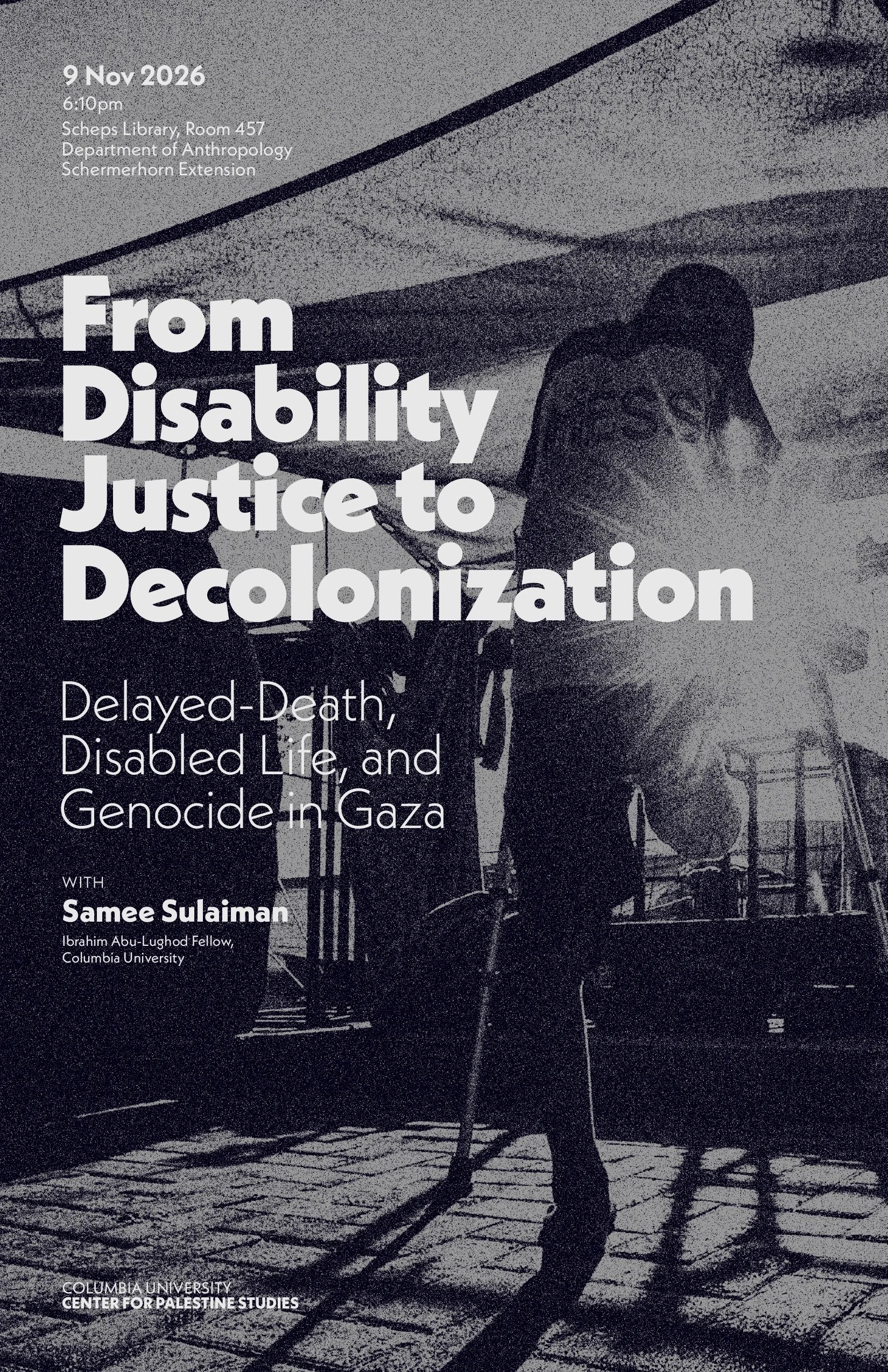
This paper examines mass disablement in Gaza as a central technology of colonial elimination and genocide. Developing the concept of “death-by-disablement,” it traces how bombardment, siege, forced displacement, and the systematic destruction of healthcare and life-sustaining infrastructure produce debility and turn survivable injuries into pathways toward premature death. Drawing on Palestinian testimony, disability justice scholarship, and reports documenting the assault on Gaza, the paper argues that disability cannot be understood solely as an outcome of war. It is also a condition deliberately produced and intensified through the deprivation of care. Ultimately, this paper argues that disability justice in Palestine cannot be achieved through humanitarian aid, medical rehabilitation, or reconstruction alone; it requires decolonization and the dismantling of the political conditions that continually produce mass injury, debility, and death.

Samee Sulaiman is an anthropologist whose research and teaching focus on disability, political violence, mobility, and social movements in Lebanon and Palestine. He received his PhD in Anthropology from Brown University in 2023 and was previously a Postdoctoral Research Associate in Palestine Studies at Yale University’s Council on Middle East Studies. His research draws on ethnographic work with Lebanese and Palestinian disability activists and organizations, examining disability politics, citizenship and non-citizenship, war, and crisis in Lebanon. His current work focuses on disability and mass disablement in Palestine, particularly in Gaza, and explores the relationship between disability justice, decolonization, reconstruction, and liberation. He is currently the Ibrahim Abu-Lughod Postdoctoral Fellow at Columbia University’s Center for Palestine Studies. Learn more about his work here.
View Event →
Ghassan Kanafani's Palestinian Resistance Literature Under Occupation, 1948-1968
Nov
12
6:10 PM18:10

Ghassan Kanafani's Palestinian Resistance Literature Under Occupation, 1948-1968

VENUE
Scheps Library, Room 457,
Department of Anthropology
Schermerhorn Extension

Advanced registration by 5pm, Tuesday, November 10, is required for all attendees, including CU/BC ID holders.

RASHID KHALIDI in conversation with ISABELLA HAMMAD about Ghassan Kanafani's “Palestinian Resistance Literature Under Occupation, 1948-1968.”

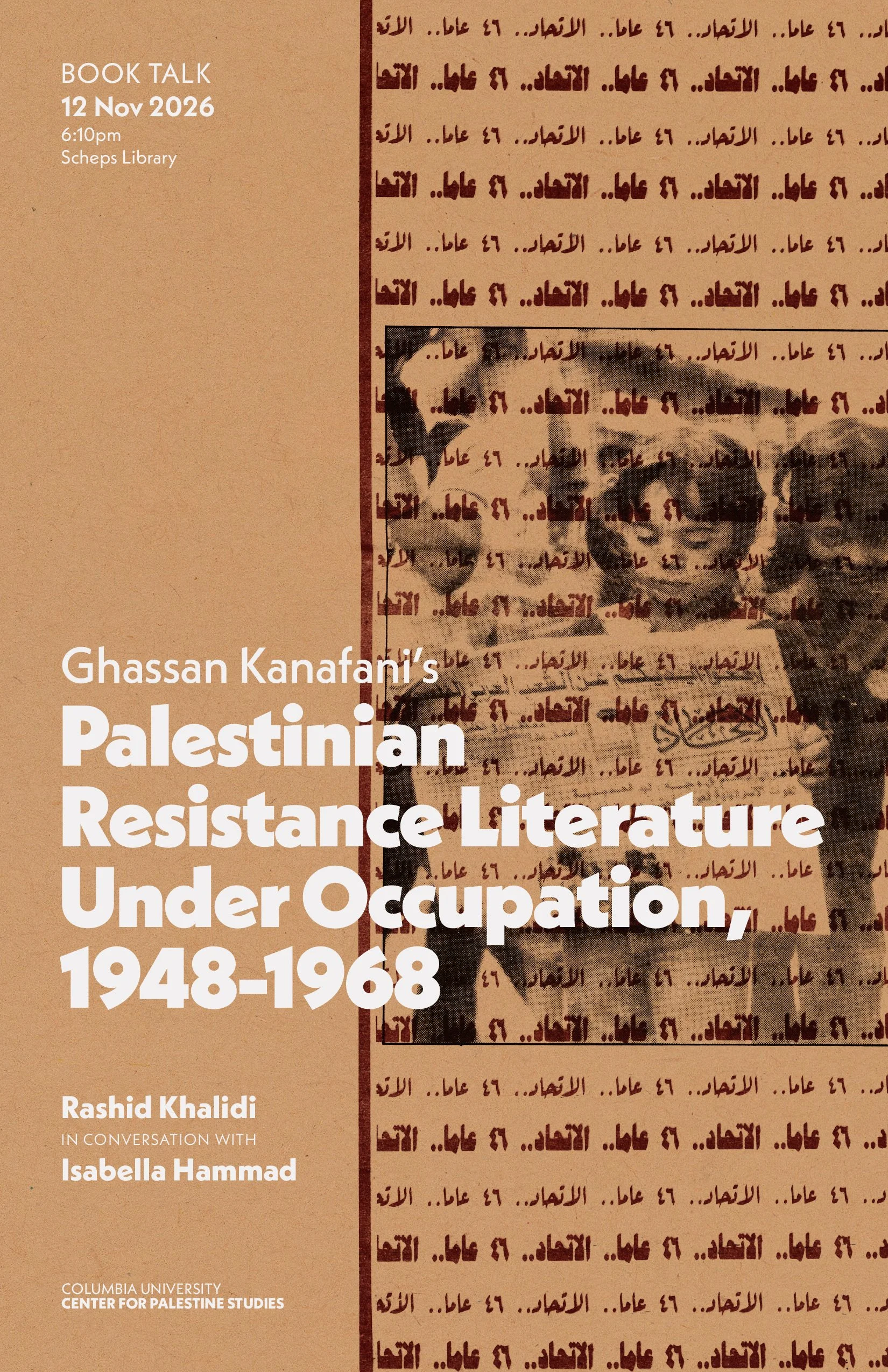
Ghassan Kanafani’s remarkable extended essay Palestinian Resistance Literature Under Occupation, 1948–1968 is an unyielding act of cultural and political endurance. Writing in the wake of Israel’s devastating territorial expansion in 1967, Kanafani elaborates his theory of resistance literature and offers a visceral account of life under occupation. Translated for the first time into English by one of the greatest living translators from Arabic to English, Tarif Khalidi, Kanafani’s essay offers one of the sharpest social and political analyses of life in Palestine in this early period of occupation.

In the two decades following the Nakba, Palestinian writers undertook the gruelling task of advancing a cultural struggle to protect their language, culture, and heritage. In addition to Kanafani’s groundbreaking essay, the book includes a selection of poetry, prose, and dramatic writing curated by Ghassan Kanafani himself. Alongside writing from Mahmoud Darwish, Hanna Abu Hanna, and Samih al-Qasim, among many others, Kanafani’s essay and the accompanying pieces stand as a defiant declaration of cultural survival in the wake of Israeli expansion.

This first English edition of Palestinian Resistance Literature Under Occupation is a joint publication with the Institute for Palestine Studies.

Copies of Palestinian Resistance Literature Under Occupation will be available for purchase at the event.

RASHID KHALIDI is Edward Said Professor Emeritus of Modern Arab Studies at Columbia University and the author of numerous books and articles, including The Hundred Years' War on Palestine (2020), a landmark history of one hundred years of war waged against the Palestinians from the foremost US historian of the Middle East, told through pivotal events and family history.

ISABELLA HAMMAD is a novelist and Writer in Residence at NYU. Her debut novel The Parisian (2019), won a Palestine Book Award, the Sue Kaufman Prize from the American Academy of Arts and Letters, and a Betty Trask Award. Her second novel Enter Ghost (2023) received the Encore Award and the Aspen Words Literary Prize. Her book-length essay Recognizing the Stranger (2024), was longlisted for the 2024 NBCC Award for Criticism.

View Event →

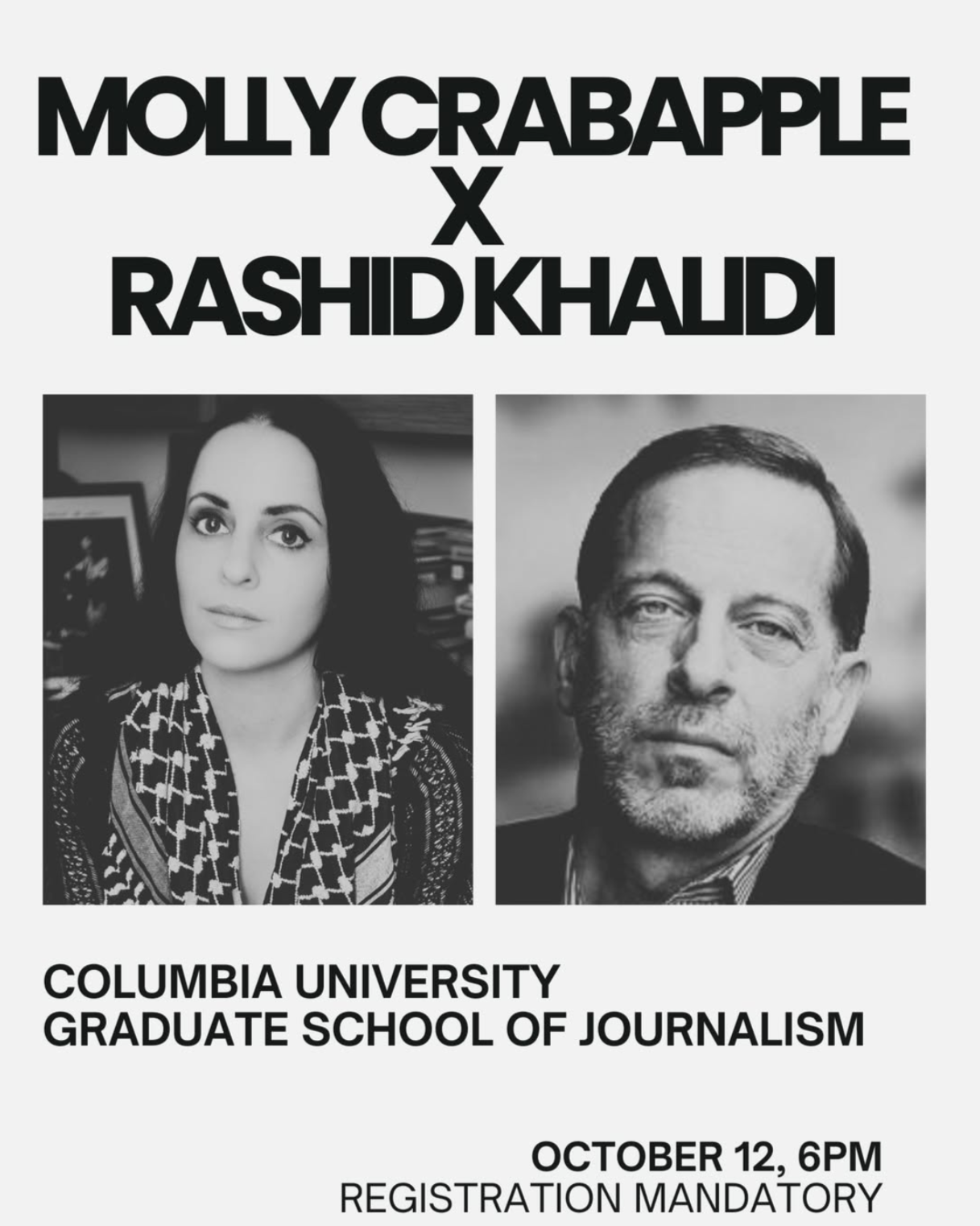
Here Where We Live Is Our Country: Molly Crabapple in Conversation with Rashid Khalidi
Oct
12
6:00 PM18:00

Here Where We Live Is Our Country: Molly Crabapple in Conversation with Rashid Khalidi

Join the Simon and June Li Center for Global Journalism, the Center for Palestine Studies, and the Committee on Global Thought for a discussion with Molly Crabapple and Rashid Khalidi about Crabapple’s new book Here Where We Live Is Our Country: The Story of the Jewish Bund.

VENUE
Columbia Journalism School
Pulitzer Hall, Lecture Hall, 3rd Floor
2950 Broadway
New York, NY 10027

Advanced registration is required for all attendees, including CU/BC ID holders.

"Vast in scope, elegiac in prose, Here Where We Live Is Our Country brings to life the profound humanity of those who stood up to the blood-soaked ethnonationalisms that led to so many of the twentieth century’s storied horrors." — Jason Stanley, New York Times bestselling author of How Fascism Works

"Here Where We Live Is Our Country is that rarest of books: a gripping, human story of love, idealism, and betrayal—and an immense, rigorous contribution to the historical record. Reading it feels revolutionary.” — Naomi Klein, New York Times bestselling author of No Logo and Doppeleganger

In the aftermath of the Holocaust, Sam Rothbort created “memory paintings” with the hope of resurrecting the vanished world of his shtetl childhood. Decades later, his great-granddaughter, the award-winning artist Molly Crabapple, discovered these paintings and one stood out: a girl, her dress the color of sky, hurling a rock through a cottage window. Itka the Bundist, Breaking Windows.

Itka is how Crabapple met the Jewish Labor Bund. Once the most influential Jewish political force in eastern Europe, the Bund was secular, socialist, and uncompromisingly anti-Zionist. The Bundists fought for dignity and equality, not in an imagined homeland in Palestine but “here where we live.”

In the first popular history of the Bund, Crabapple re-creates their extraordinary world through dramatic portraits of insurgent poets and antireligious rebels, clandestine revolutionaries and lovers on the barricades. The Bundists live deeply within this violent, volatile, and somehow hopeful period, as their stories interweave with the Russian Revolution and the Holocaust. The Bund’s rise and fall raises the vital question: What can we learn from a movement that, for all its toughness, imagination, and moral clarity, was largely destroyed?

Here Where We Live Is Our Country reanimates a band of idealists who broadened our global political imagination. As we once again contend with nationalism, repression, and the struggle for belonging, the Bund’s remarkable story and message—that liberation, dignity, and solidarity must begin where we stand—reaches across time as a guide to our own urgent moment.

Copies of Here Where We Live Is Our Country will be available for purchase.

This event is sponsored by the Simon and June Li Center for Global Journalism, the Center for Palestine Studies, and the Committee on Global Thought at Columbia University.

View Event →
Edward Said: The Politics of an Oppositional Intellectual: An Evening with Nubar Hovsepian
Oct
6
6:10 PM18:10

Edward Said: The Politics of an Oppositional Intellectual: An Evening with Nubar Hovsepian

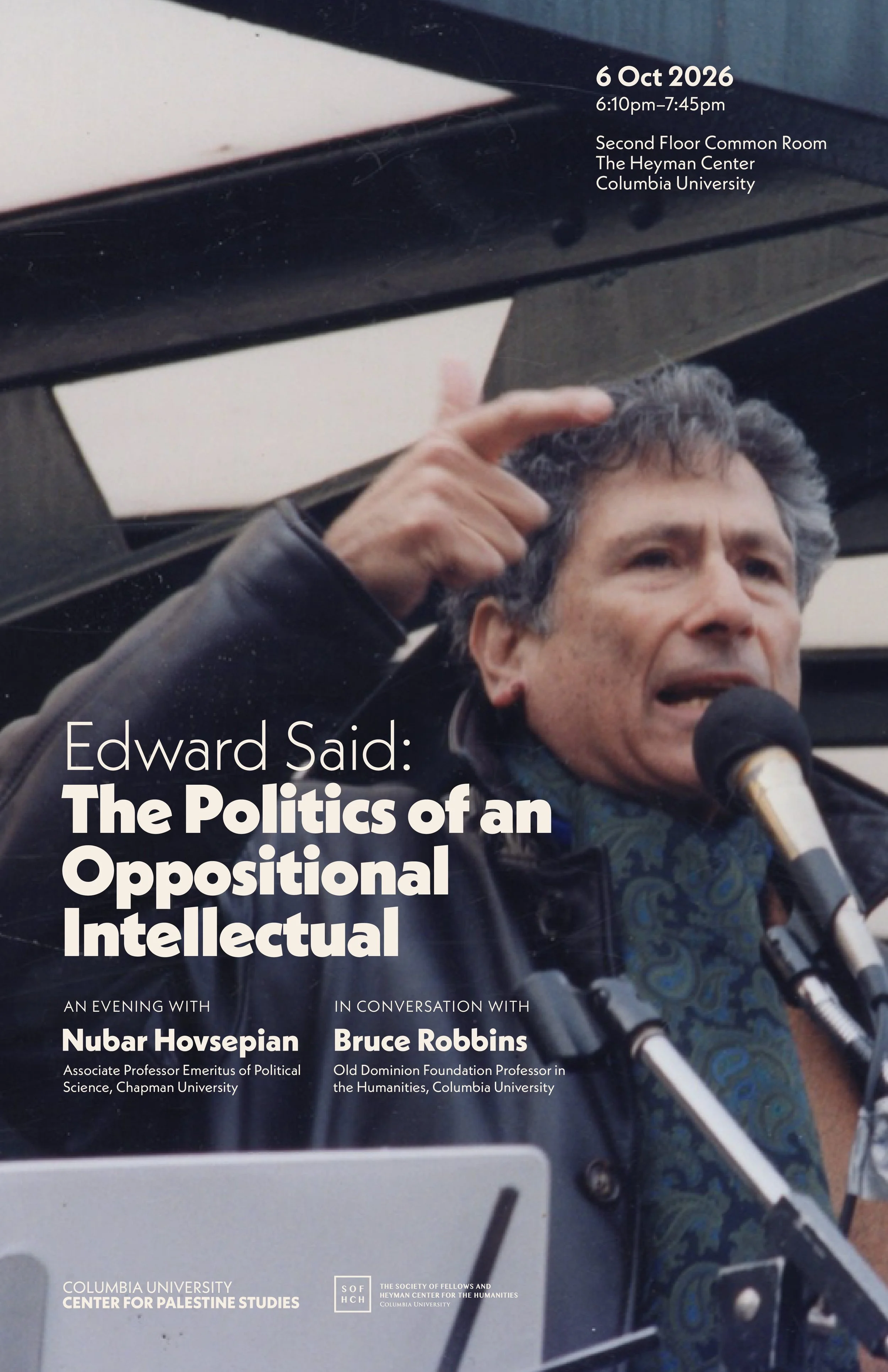
Nubar Hovsepian’s new book, “Edward Said: The Politics of an Oppositional Intellectual,” deals with a simple question: How does Said’s Humanism inform his politics, on Palestine, the Middle East and US policies? Nubar Hovsepian will read excerpts from his book and be joined in conversation by Bruce Robbins.

VENUE
Second Floor Common Room
The Heyman Center
Columbia University
Click here for a map


Advanced registration is required for all attendees, including CUID holders.


Nubar Hovsepian
is Associate Professor Emeritus of Political Science, Chapman University. He is the author of Edward W. Said: The Politics of an Oppositional Intellectual (2025) and Palestinian State Formation: Education and the Construction of National Identity (Cambridge Scholars Publishing, 2009) and he edited and contributed to The War on Lebanon (Interlink Publishers, 2008).  He has also written and edited four books in Arabic, most notably on the Iranian revolution of 1979, and has published articles in professional journals, newspapers, and magazines in various parts of the world. Hovsepian has devoted enormous time to the Israel/Palestine conflict, and served, from 1982 to 1984, as Political Affairs Officer for the United Nations Conference on the Question of Palestine.

Bruce Robbins is Old Dominion Foundation Professor in the Humanities, Columbia University. His most recent books are Who's Allowed to Protest? (Melville House, 2026) and Teaching Politically (Fordham, 2025), coedited with May Hawas. Atrocity: A Literary History (Stanford, 2025), won the Wellek Prize for the best monograph in Comparative Literature. He is also the author of Criticism and Politics: A Polemical Introduction (Stanford, 2022), The Beneficiary (Duke, 2017), and Cosmopolitanisms, co-edited with Paulo Horta (NYU, 2017).  His essays have appeared in The Baffler, n+1, The Nation, The New Statesman, Public Books, the London Review of Books, and the LA Review of Books. His efforts on behalf of justice for Palestine began in 2002, when he collaborated (with the physicist Alan Sokal) on an "Open Letter of American Jews to Our Government" that called for cutting off American aid to Israel if Israel refused to recognize the relevant United Nations resolutions.  The "Open Letter" was published in the New York Times with over 4000 signatures and translated into various languages.  He is the director of two documentaries, “Some of My Best Friends Are Zionists” and “What Kind of Jew Is Shlomo Sand?” His book Why Read Said Now? is forthcoming from Polity in 2027.


Organzed by the Center for Palestine Studies
& co-sponsored by The Society of Fellows and Heyman Center for the Humanities.


“Edward Said, the well-known Palestinian American intellectual, did not set out to be a partisan provocateur; if, more than two decades after his death, his work is treated as though he had been merely an ideologue or simply a shill for the Palestine Liberation Organization, it is a testament to the deeply debased quality of today’s debate about the Middle East rather than a reflection of his scholarship and public writing. Hovsepian, a U.S.-based academic, was Said’s friend, admirer, confidant, and sometime sparring partner. Drawing on his own diaries and Said’s unpublished letters and manuscripts, Hovsepian sketches both the portrait of a friendship and an intellectual biography. From Said’s early focus on music and English literature to his political awakening in the aftermath of the 1967 Six-Day War, Hovsepian traces Said’s evolving arguments about the relationship between culture and politics, best exemplified in Orientalism, Said’s most influential work, and his shifting conceptions of humanism and nationalism. As Said turned his skills as a literary critic to political analysis, he understood it as the responsibility of an intellectual to test conventional wisdom and challenge the complacency of the powerful, including the PLO, the U.S. government, and those he considered their apologists. This book is a useful reminder of the value of such critical perspectives.” 

Lisa Anderson, Foreign Affiars 

View Event →
A Living Archive: The Many Lives of Palestinian Songs
Oct
1
6:10 PM18:10

A Living Archive: The Many Lives of Palestinian Songs

Join the Center for Palestine Studies for a lecture demonstration by Tareq Abboushi,
with Taoufik Ben-Amor.

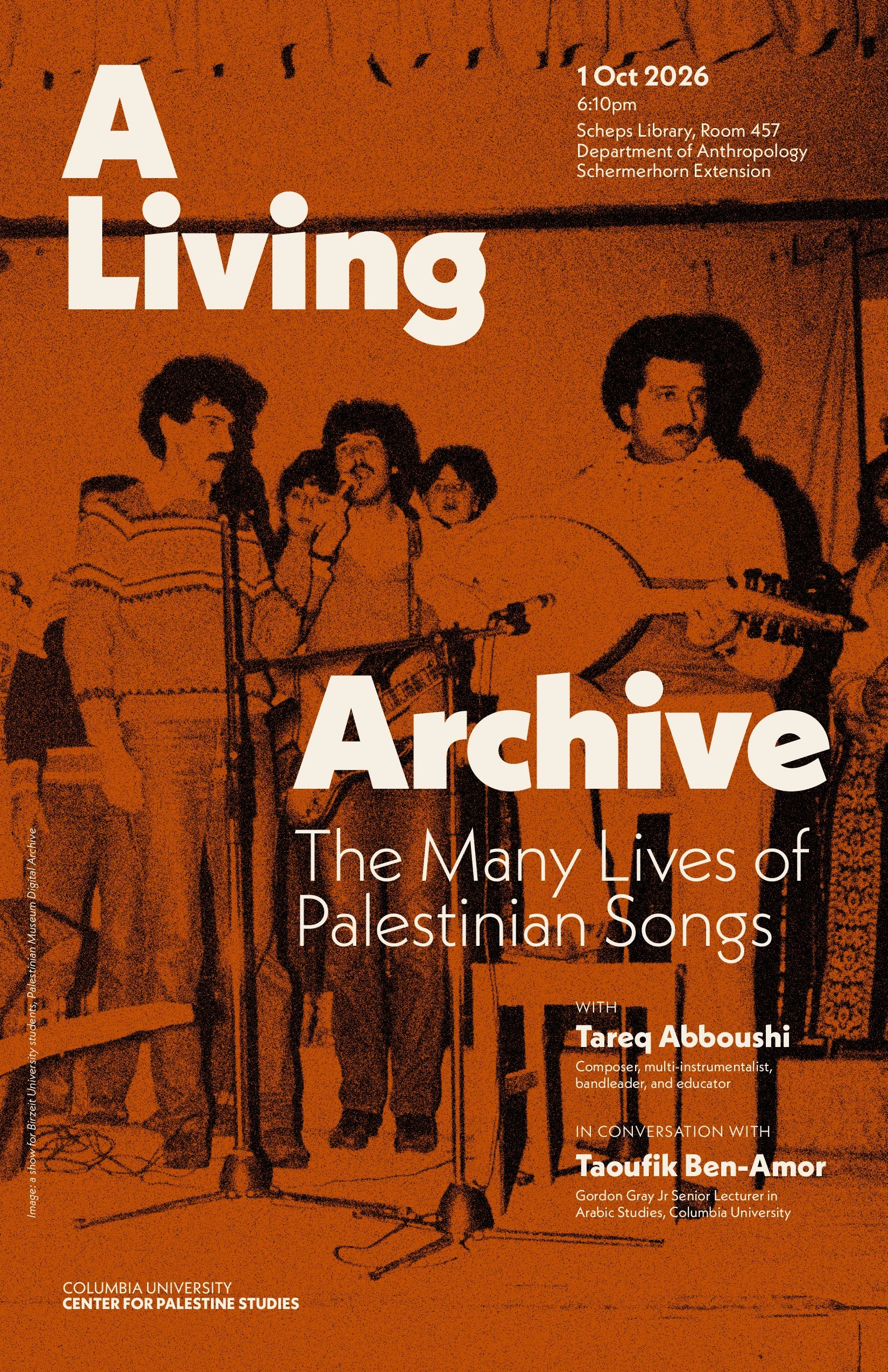
The past five decades have seen several deliberate efforts to archive Palestinian popular songs by initiatives such as The Palestinian Sound Archive and The Palestinian Folk Music Archive, as well as music and dance troupes, such as Al-Hannouneh and Al-Funoun, and individual singers like Sanaa Moussa, Reem Kilani, Rim Banna, and many others. These songs, however, are not frozen in the archive, but are constantly reinterpreted musically and poetically with many variations and additions. Thus, these songs remain open and alive—a living archive of a collective memory.

VENUE
Scheps Library, Room 457,
Department of Anthropology,
Schermerhorn Extension


Advanced registration by Tuesday, September 29,
is required for all attendees, including CU/BC ID holders.

Seating is on a first-come, first-serve basis; registration does not guarantee a seat.


Tareq Abboushi
is a composer, multi-instrumentalist, bandleader, and educator. After graduating with honors from William Paterson University with a Jazz Piano Performance degree, Abboushi decided to pursue the buzuq as a means to explore Arab Music. As a performer this led him to collaborate with such notable musicians as Simon Shaheen, Omar Farouk Tekbilek, Suad Massi, Abeer Nehme, and Lotfi Bouchnak. As an award winning composer, his diverse background can be heard across multiple genres ranging from classical Arab, to Jazz, Electronic, film scoring, dance projects, radio, television, as well as commissioned soundscape design for art projects. Abboushi’s discography includes two albums with his band SHUSMO, five albums with Amir ElSaffar, and appearances on many other albums including three with Grammy-winner Dan Zanes. His extensive experience in various styles of music has also made him an invaluable teacher, with a global profile including lectures at Columbia University, NYU, Juilliard, The Museum of the City of New York, Birzeit University, Agder University, and the Edward Said National Conservatory of Music.

Taoufik Ben-Amor is the Gordon Gray Jr Senior Lecturer in Arabic Studies, Columbia University. He specializes in Arabic language and linguistics, language and identity, Arab music, and music in Sufism. His research combines his interests in music, language and identity in the Arab world through the study of lyrics.

View Event →