Filtering by: History of the Present
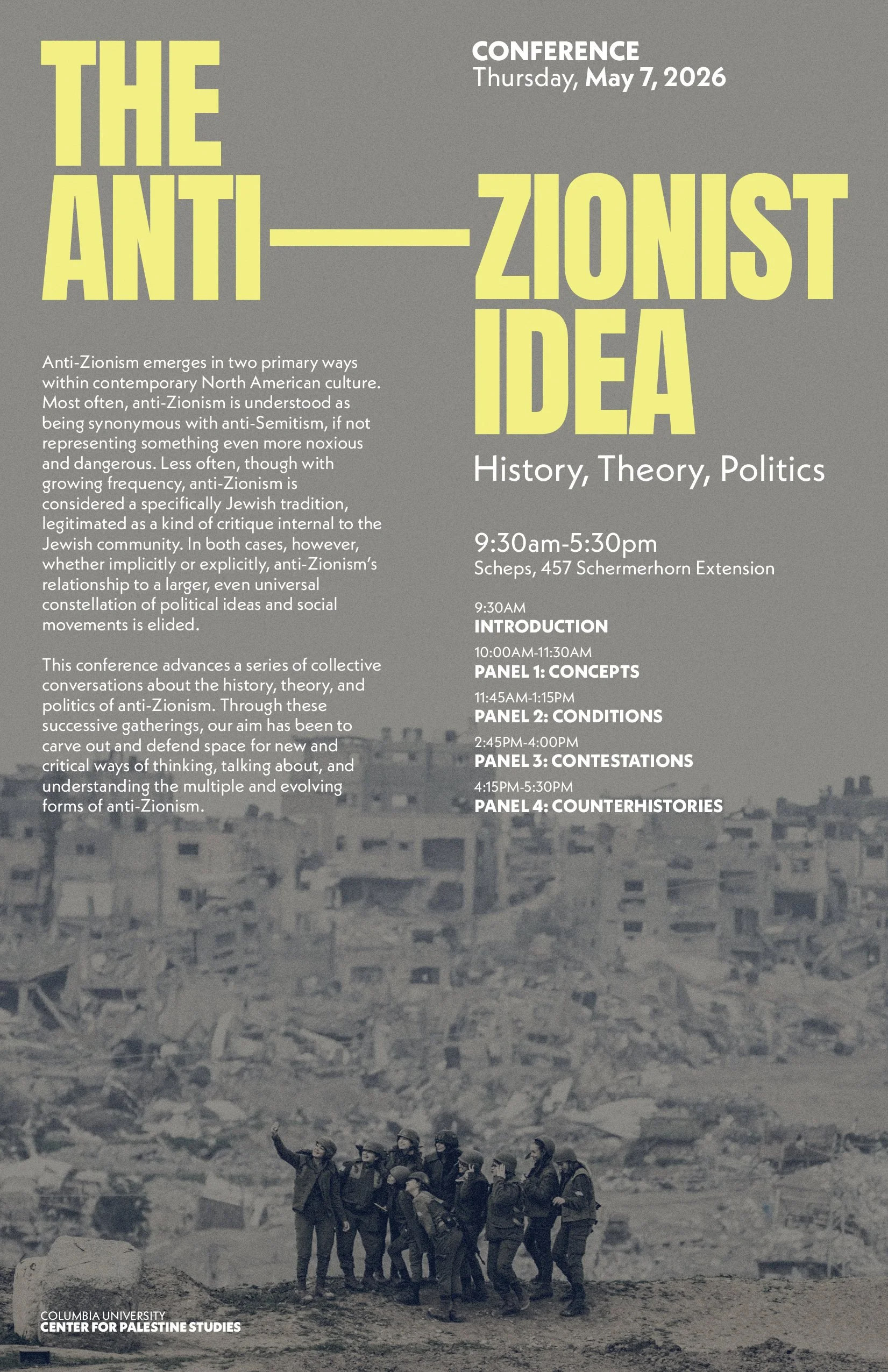
The Anti-Zionist Idea: History, Theory, Politics
May
7
9:30 AM09:30

The Anti-Zionist Idea: History, Theory, Politics

Anti-Zionism emerges in two primary ways within contemporary North American culture. Most often, anti-Zionism is understood as being synonymous with anti-Semitism, if not representing something even more noxious and dangerous. Less often, though with growing frequency, anti-Zionism is considered a specifically Jewish tradition, legitimated as a kind of critique internal to the Jewish community. In both cases, however, whether implicitly or explicitly, anti-Zionism’s relationship to a larger, even universal constellation of political ideas and social movements is elided. This workshop advances a series of collective conversations about the history, theory, and politics of anti-Zionism. Through these successive gatherings, our aim has been to carve out and defend space for new and critical ways of thinking, talking about, and understanding the multiple and evolving forms of anti-Zionism.

Organized by Esmat Elhalaby (University of Toronto) and Max Weiss (Princeton University) and hosted by the Center for Palestine Studies.

VENUE
Scheps Library, Room 457,
Department of Anthropology
Schermerhorn Extension
Campus Map


9:30 AM
Introduction

10:00-11:30 AM
Panel 1: Concepts

11:45-1:30 PM
Panel 2: Conditions

1:30-2:45 PM
Lunch

2:45-4:00
Panel 3: Contestations 

4:00-5:30
Panel 4: Counterhistories 

View Event →
Criminalization, capitalization, and intercommunal killings in Israel-Palestine
May
12
9:00 AM09:00

Criminalization, capitalization, and intercommunal killings in Israel-Palestine
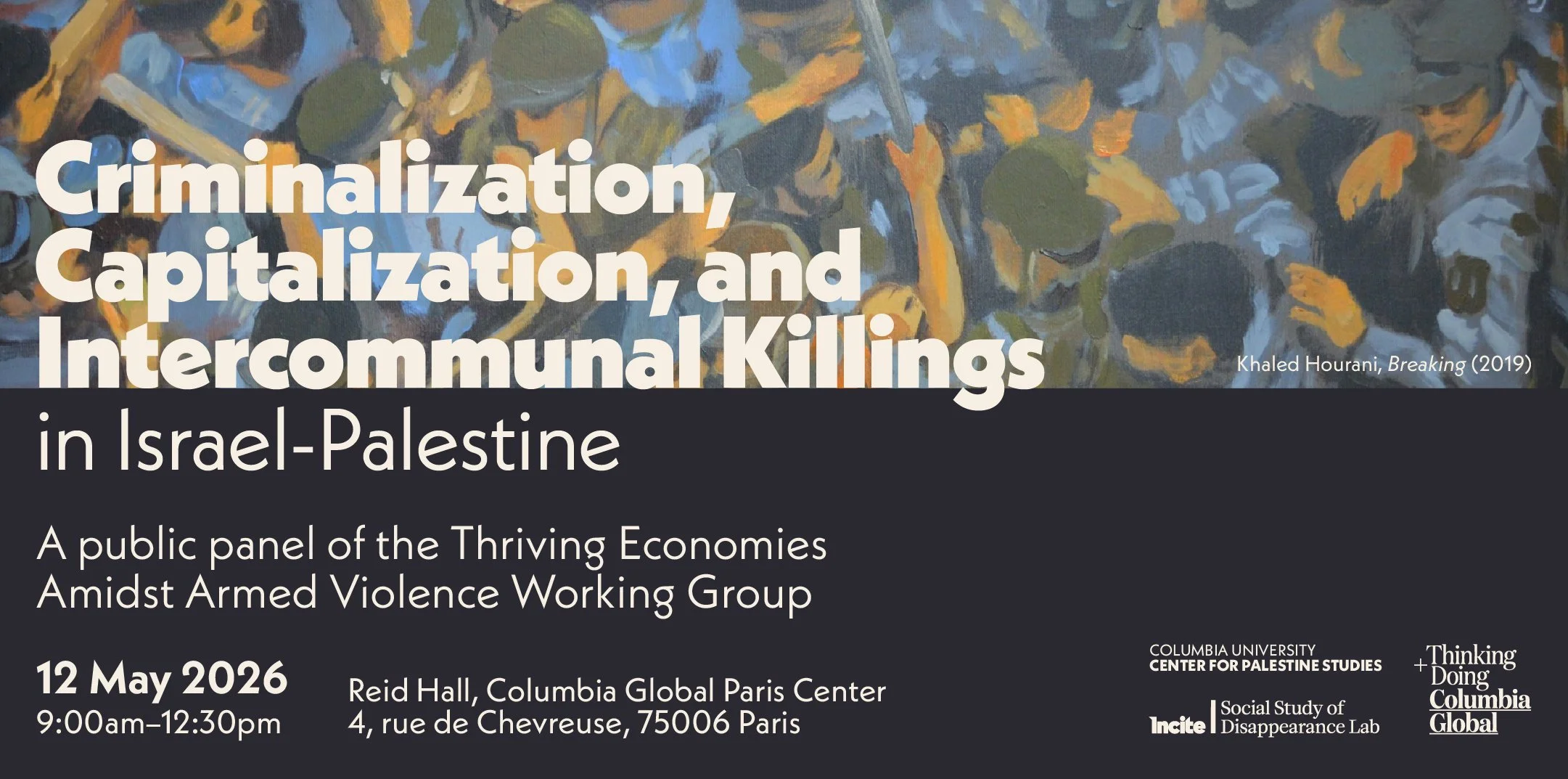
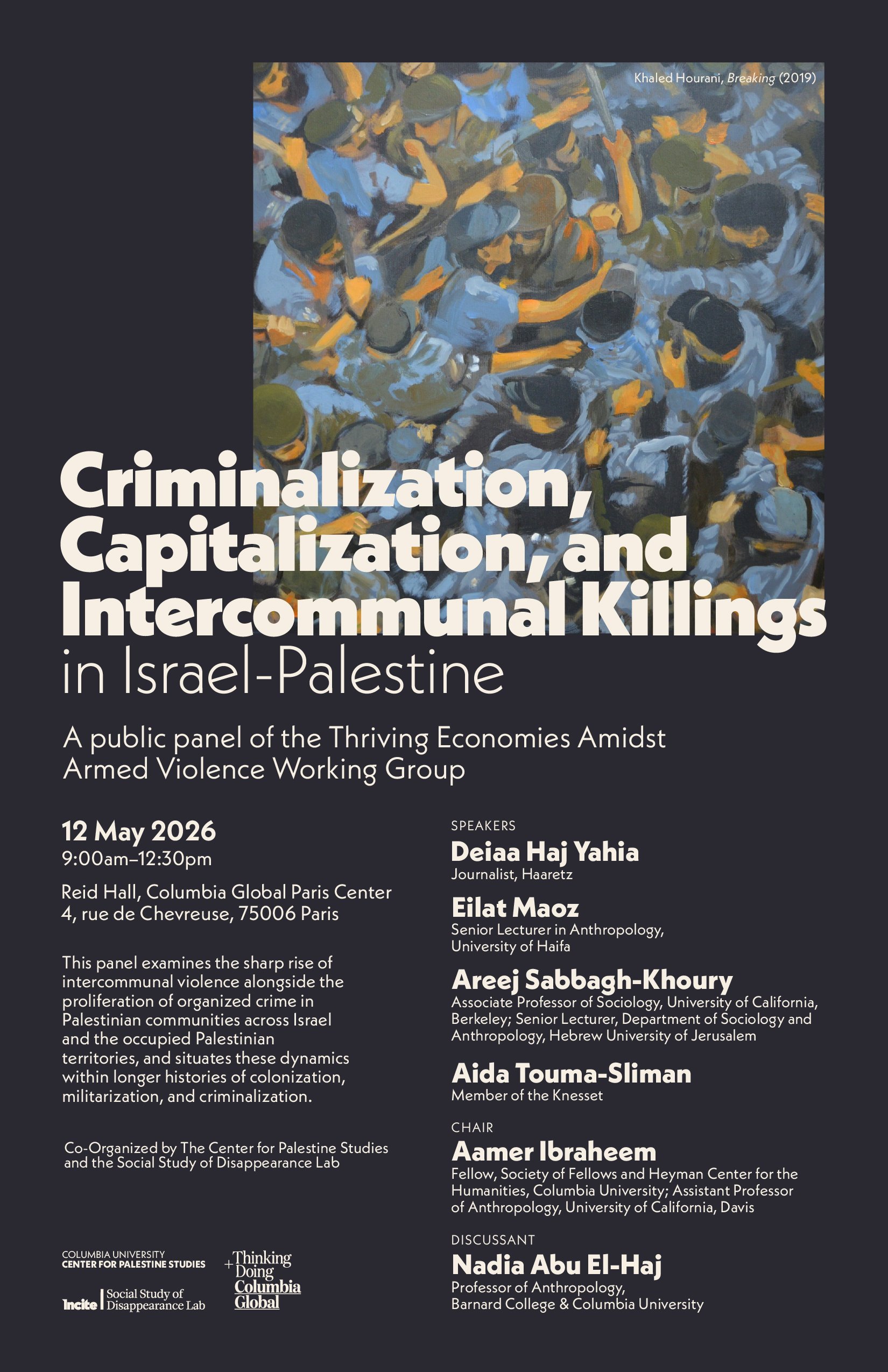
This panel is part of the Thriving Economies Amidst Armed Violence project and its associated working group, and extends conversations from the conference held at Reid Hall. Over the past decade, Palestinian communities in Israel and the occupied Palestinian territories have experienced an unprecedented upsurge in intercommunal violence alongside the proliferation of organized crime. Daily shootings, explosions, assaults, stabbings, homicides, and extortion have increasingly shaped social life, affecting approximately 2.1 million Palestinian citizens of Israel (around 20% of the population) and 5 million Palestinians in the occupied territories, pointing to profound transformations in social relations.

This reality has generated multiple responses. Israeli state authorities have acknowledged the risks posed to public safety and the rule of law, developing new policing strategies to address these dynamics. At the same time, Palestinian citizens have organized community-based responses while also raising critiques of state inaction, neglect, and forms of complicity. These critiques situate contemporary violence within longer trajectories of colonization, militarization, and criminalization, highlighting how processes of exclusion, uneven incorporation, segregation, and underdevelopment create conditions for the expansion of organized crime.

The panel examines what participants describe as a “crime–criminalization nexus”: the evolving and often ambiguous relationships—conflictive, complicit, and associative—between state actors, security agencies, and individuals or groups drawn into violence and criminalized activity. It considers how categories such as “crime families,” “gangs,” and “terrorist organizations” are defined and mobilized through state practices, and how these designations shape both governance and everyday life.

At the same time, the discussion explores how those targeted by criminalization and militarized intervention respond to and reshape these processes. It brings into conversation perspectives from multiple fields—including policing, military and intelligence services, journalism, law, and academic research—that seek to define, regulate, or contest forms of violence and “national security” threats.

Focusing on both the agents and targets of criminalization, the panel examines transformations and continuities in social relations and forms of political and economic control. It situates these dynamics within broader historical and structural contexts, including shifts in colonial governance, changing forms of security intervention, transformations in political-economic conditions, and the wider social networks within which criminalized groups are embedded.

To attend remotely via Zoom, please use the link below to join at
9:30AM (Paris); 10:30AM (Jerusalem); 3:30AM (New York)

Zoom Link


SPEAKERS
Deiaa Haj Yahia, Journalist, Haaretz

Eilat Maoz, Senior Lecturer in Anthropology, University of Haifa

Areej Sabbagh-Khoury, Associate Professor of Sociology, University of California, Berkeley; Senior Lecturer, Department of Sociology and Anthropology, Hebrew University of Jerusalem

Aida Touma-Sliman, Member of the Knesset


DISCUSSANT
Nadia Abu El-Haj,
Professor of Anthropology, Columbia University and Barnard College


CHAIR
Aamer Ibraheem, Fellow, Society of Fellows and Heyman Center for the Humanities, Columbia University; Assistant Professor of Anthropology, University of California, Davis


EVENT ORGANIZERS
Nadia Abu El-Haj, Professor of Anthropology, Columbia University

Naor Ben-Yehoyada, Assistant Professor of Anthropology, Columbia University

Claudio Lomnitz, Professor of Anthropology, Columbia University

Co-Organized by the Center for Palestine Studies and the Social Study of Disappearance Lab


The project Thriving Economies Amidst Armed Violence is funded by Columbia Global at Columbia University. Columbia Global brings together major global initiatives from across Columbia University to advance knowledge and foster global engagement.

This event is part of that broader project. Additional support for the project is provided by the Alliance Program (Sciences Po / Columbia University), INCITE at Columbia University, and the Center for International Studies (CERI).
View Event →

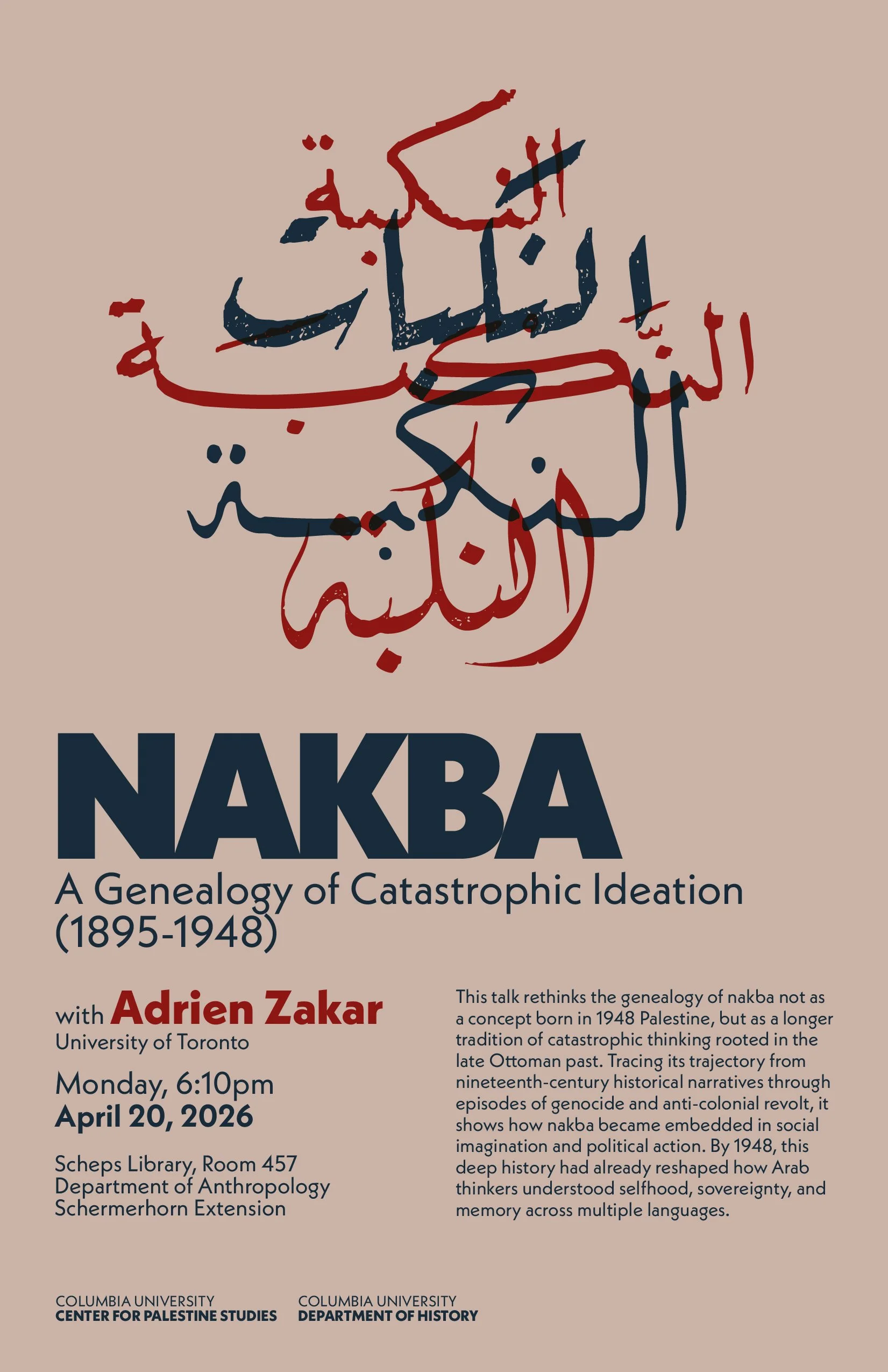
Nakba: A Genealogy of Catastrophic Ideation (1895-1948)
Apr
20
6:10 PM18:10

Nakba: A Genealogy of Catastrophic Ideation (1895-1948)

TIME
6:10PM
Monday, April 20


VENUE
Scheps Library, Room 457,
Department of Anthropology
Schermerhorn Extension

This talk examines the formation of “nakba” as a concept of disaster and a social practice of catastrophic ideation in Arabic. Contrary to the prevailing assumption, the genealogy of nakba does not begin in 1948 Palestine; it stretches far back into the Ottoman past. Zakar traces nineteenth-century constructions, when nakba referred to medieval episodes of downfall, and examine how Arab publics later redeployed them during the Hamidian massacres (1894-97), the Armenian/Assyrian Genocide (1915), and colonial wars, including the Great Syrian Revolt (1925) and the Great Arab Revolt (1936-39). These events entrenched a structure of the imagination that enmeshed nakba with social formation and political action, in echo with a wider conceptual landscape of catastrophe. Zakar then turns to 1948 Palestine, when the Nakba prompted Arab social scientists to redefine selfhood, sovereignty, and objectivity. This stratified pre-1948 genealogy reveals how catastrophic ideation generated sites of memory and practices of oblivion across Arabic, Turkish, Armenian, and English since the nineteenth-century onward.

ADRIEN ZAKAR is Assistant Professor in the Near and Middle East Civilizations Department and the Institute for the History and Philosophy of Science and Technology at the University of Toronto. His writings have appeared in the International Journal of Middle East Studies; Anthropology Today; Transbordeur; the International Journal of Turkish Studies; Comparative Studies of South Asia, Africa, and the Middle East; and the American Historical Review. Zakar is currently working on a manuscript tracing the history of vision and modern mapping in the late Ottoman Empire and in interwar Lebanon and Syria.

Introduction
BRIAN BOYD is Senior Lecturer, Director of Museum Anthropology in the Department of Anthropology, and Co-Director of the Center for Palestine Studies.

Organized by the Center for Palestine Studies and co-presented with the Department of History.


This talk is based on Adrien Zakar’s newly published article:

Adrien Zakar, “Nakba: Catastrophic Ideation and the Meanings of Disaster (1895–1948),” The American Historical Review 131, no. 1 (March 2026): 114–142.

https://academic.oup.com/ahr/article/131/1/114/8542217?login=true

View Event →
Contours of Thought: The Humanities and the Possibilities of Anti-Discipline
Apr
16
to Apr 17

Contours of Thought: The Humanities and the Possibilities of Anti-Discipline

VENUE
Second Floor Common Room
The Heyman Center
Columbia University
Click here for a printable PDF download of the map


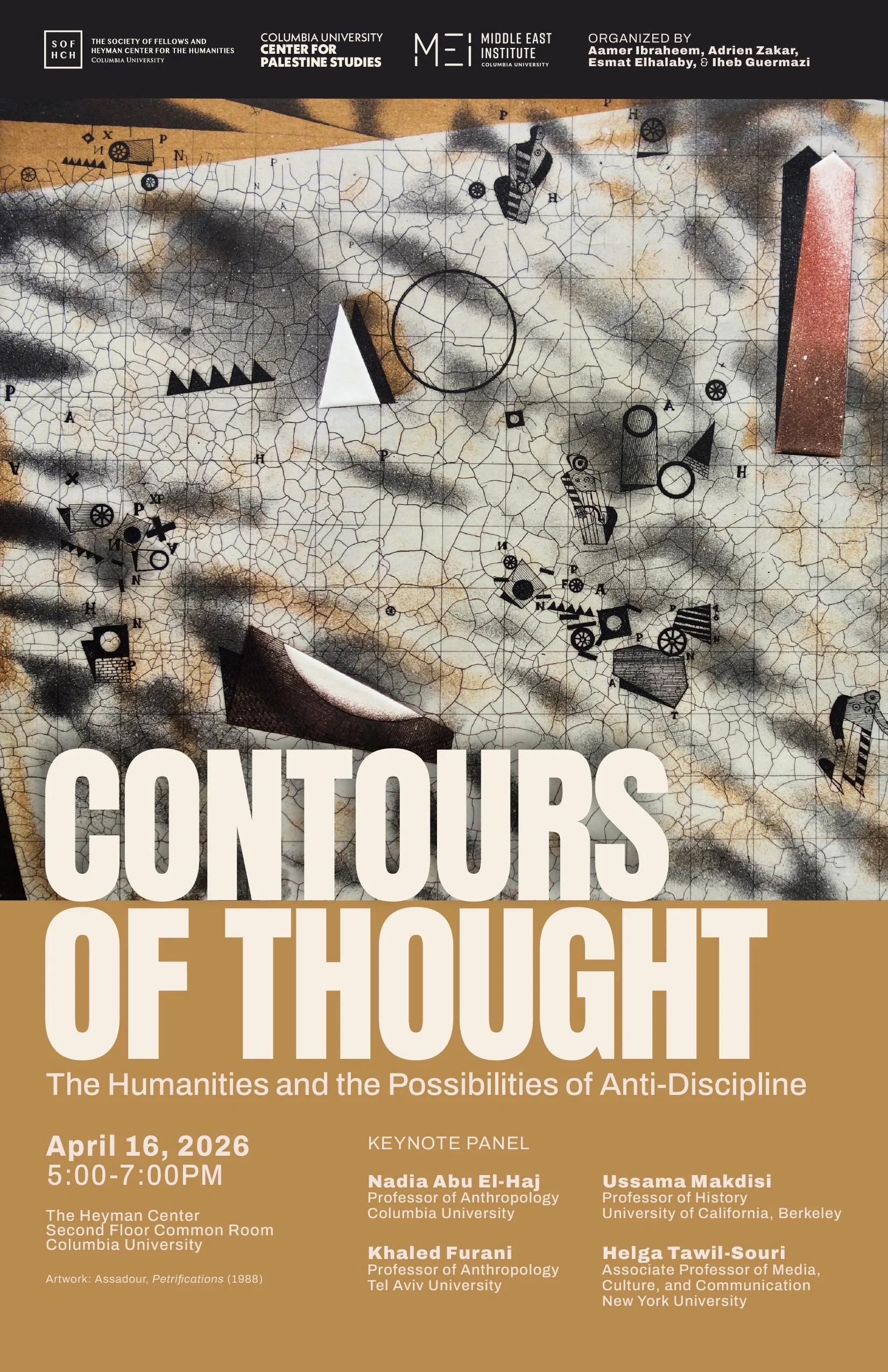
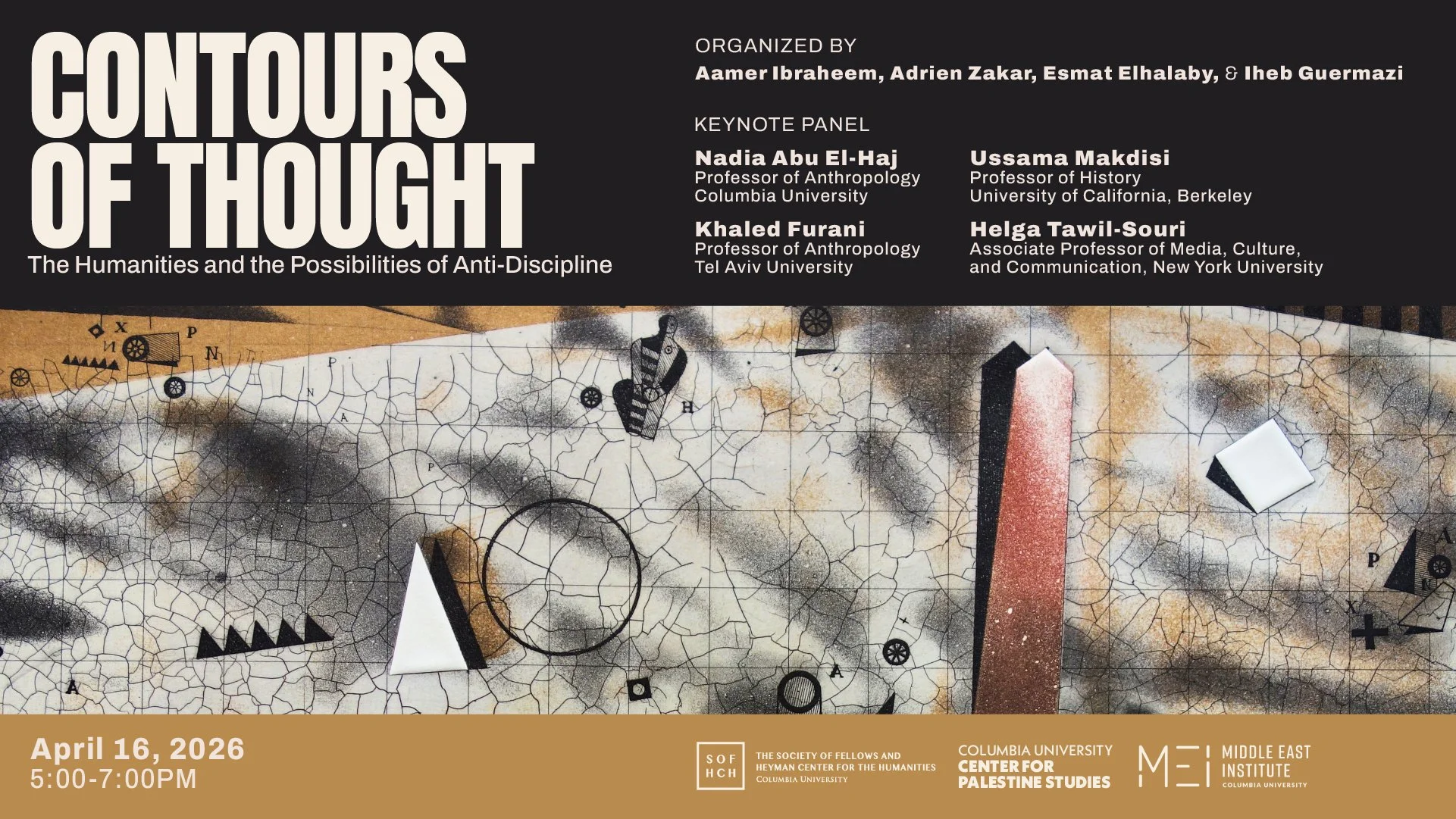
This symposium brings together scholars working across and beyond Middle East and North Africa studies to explore how discursive fields are constituted, and to ask what becomes possible when we read across and against established disciplinary and regional boundaries. Rather than simply juxtaposing area studies frameworks (e.g., Syria or Palestine), we aim to theorize “the regional” anew. This conversation began as an exchange around Syro-Palestine, reflecting on how regional fields—particularly those of Lebanon, Turkey, Tunisia, and Algeria—have been positioned in relation to the Question of Palestine. This positioning has tended to circumscribe the terrain of inquiry, foreclosing other narratives, epistemologies, and questions. Our symposium aims to explore a conceptual vocabulary that resists colonial inheritances and disciplinary segmentation, and that reimagines scholarly methods through forms of relation not yet captured by dominant frameworks.

The two-day program includes a Thursday evening keynote panel featuring four speakers, open to the public and the Columbia community, followed by three closed-door sessions on Friday with a cohort of invited scholars.

SYMPOSIUM CO-ORGANIZERS

Esmat Elhalaby, Assistant Professor in History, University of Toronto

Iheb Guermazi, The Society of Fellows and Heyman Center for the Humanities at Columbia University

Aamer Ibraheem, Assistant Professor in Anthropology, and a Mellon Postdoctoral Fellow, University of California, Davis & The Society of Fellows and Heyman Center for the Humanities at Columbia University.

Adrien Zakar, Assistant Professor of Middle East Studies and the History of Science and Technology, University of Toronto.

This symposium is organized by The Society of Fellows and Heyman Center for the Humanities and co-sponsored by Center for Palestine Studies, Middle East Institute, and the Department of Middle Eastern, South Asian, and African Studies.

CONTACT sofheyman@columbia.edu


THURSDAY PUBLIC KEYNOTE PANEL

Nadia Abu El-Haj
Professor of Anthropology
Columbia University & Barnard College

Khaled Furani
Professor of Anthropology
Tel Aviv University

Ussama Makdisi
Professor of History
University of California, Berkeley

Helga Tawil-Souri
Associate Professor of Media, Culture, and Communication
New York University


FRIDAY ROUNDTABLE
(closed to the public)

Ilham Khuri-Makdisi
Associate Professor of History
Northeastern University

Fadi A Bardawil
Associate Professor of Contemporary Arab Cultures
Duke University

Seda Altuğ
Independent Scholar

Reem Bailony
Associate Professor in History
Agnes Scott College

Youssef Ben Ismail
Assistant Professor of Law, Jurisprudence, and Social Thought
Amherst College

Margaux Fitoussi
Assistant Professor in Anthropology
University of California, Irvine

Idriss Jebari
Assistant Professor in the Department of Communication and Media Studies
Trinity College, Dublin

Saphe Shamoun
PhD Candidate in Anthropology
Columbia University

FRIDAY MODERATORS / DISCUSSANTS
Julia Elyachar
Associate Professor in Anthropology
Princeton University

Marwa Elshakry
Professor in History
Columbia University

View Event →