
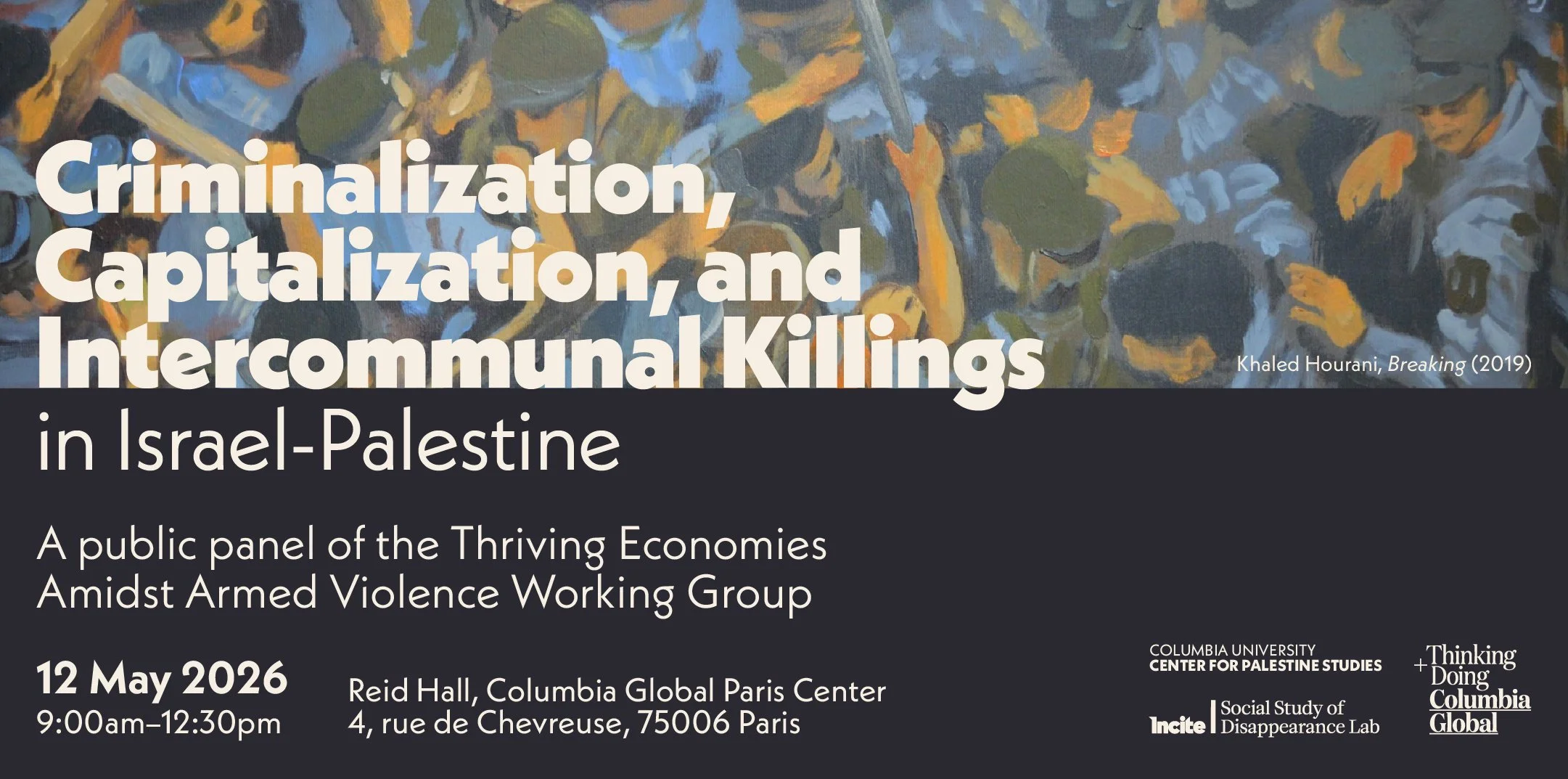
This panel is part of the Thriving Economies Amidst Armed Violence project and its associated working group, and extends conversations from the conference held at Reid Hall. Over the past decade, Palestinian communities in Israel and the occupied Palestinian territories have experienced an unprecedented upsurge in intercommunal violence alongside the proliferation of organized crime. Daily shootings, explosions, assaults, stabbings, homicides, and extortion have increasingly shaped social life, affecting approximately 2.1 million Palestinian citizens of Israel (around 20% of the population) and 5 million Palestinians in the occupied territories, pointing to profound transformations in social relations.
This reality has generated multiple responses. Israeli state authorities have acknowledged the risks posed to public safety and the rule of law, developing new policing strategies to address these dynamics. At the same time, Palestinian citizens have organized community-based responses while also raising critiques of state inaction, neglect, and forms of complicity. These critiques situate contemporary violence within longer trajectories of colonization, militarization, and criminalization, highlighting how processes of exclusion, uneven incorporation, segregation, and underdevelopment create conditions for the expansion of organized crime.
The panel examines what participants describe as a “crime–criminalization nexus”: the evolving and often ambiguous relationships—conflictive, complicit, and associative—between state actors, security agencies, and individuals or groups drawn into violence and criminalized activity. It considers how categories such as “crime families,” “gangs,” and “terrorist organizations” are defined and mobilized through state practices, and how these designations shape both governance and everyday life.
At the same time, the discussion explores how those targeted by criminalization and militarized intervention respond to and reshape these processes. It brings into conversation perspectives from multiple fields—including policing, military and intelligence services, journalism, law, and academic research—that seek to define, regulate, or contest forms of violence and “national security” threats.
Focusing on both the agents and targets of criminalization, the panel examines transformations and continuities in social relations and forms of political and economic control. It situates these dynamics within broader historical and structural contexts, including shifts in colonial governance, changing forms of security intervention, transformations in political-economic conditions, and the wider social networks within which criminalized groups are embedded.
To attend remotely via Zoom, please use the link below to join at
9:30AM (Paris); 10:30AM (Jerusalem); 3:30AM (New York)
SPEAKERS
Deiaa Haj Yahia, Journalist, Haaretz
Eilat Maoz, Senior Lecturer in Anthropology, University of Haifa
Areej Sabbagh-Khoury, Associate Professor of Sociology, University of California, Berkeley; Senior Lecturer, Department of Sociology and Anthropology, Hebrew University of Jerusalem
Aida Touma-Sliman, Member of the Knesset
DISCUSSANT
Nadia Abu El-Haj, Professor of Anthropology, Columbia University and Barnard College
CHAIR
Aamer Ibraheem, Fellow, Society of Fellows and Heyman Center for the Humanities, Columbia University; Assistant Professor of Anthropology, University of California, Davis
EVENT ORGANIZERS
Nadia Abu El-Haj, Professor of Anthropology, Columbia University
Naor Ben-Yehoyada, Assistant Professor of Anthropology, Columbia University
Claudio Lomnitz, Professor of Anthropology, Columbia University
Co-Organized by the Center for Palestine Studies and the Social Study of Disappearance Lab
The project Thriving Economies Amidst Armed Violence is funded by Columbia Global at Columbia University. Columbia Global brings together major global initiatives from across Columbia University to advance knowledge and foster global engagement.
This event is part of that broader project. Additional support for the project is provided by the Alliance Program (Sciences Po / Columbia University), INCITE at Columbia University, and the Center for International Studies (CERI).