ATTEND | Chronic Erasure w/ Mazen Iwaisi, 11/12/25

Chronic Erasure: Reflection on Archive, Curation, and Storage in Palestine under Israeli Settler Colonialism

Wednesday, November 12, 2025
Bertelsmann Campus Center
Weis Cinema
Bard College

Mazen Iwaisi's research examines how Israeli settler colonialism operates through archaeological archival practices to disrupt Palestinian presence and state-building processes. Employing institutional ethnography and archival analysis, he investigates how archives become sites of contestation between colonial erasure and Palestinian institutional development. Israeli settler colonialism undermines Palestinian heritage institutions through "chronic erasure"—manipulating temporal frameworks that destroy present Palestinian connections whilst fabricating alternative Israeli narratives. Palestinian state-building efforts resist these processes through institutional archaeology, creating archives that assert sovereignty and cultural continuity despite occupation.

Cases from Gaza's emergency artefact preservation and West Bank excavations reveal how Palestinian archival practices embody resistance, establishing knowledge infrastructures whilst confronting colonial dispossession. The Palestinian Department of Antiquities exemplifies this tension, navigating resource constraints and political limitations whilst building institutional capacity for heritage preservation. This demonstrates how Palestinian archival work transcends documentation, functioning as state-building acts that assert Palestinian historical presence while constructing institutional frameworks for cultural preservation and national continuity. These practices counter settler colonial temporality by maintaining Palestinian cultural memory against systematic erasure.
 

This event is co-sponsored by the Center for Curatorial Studies, the Human Rights Project and the Anthropology program at Bard College.

ATTEND | The Part which Has Two Parts w/ Aamer Ibraheem, 11/6/25

Join the Society of Fellows and the Heyman Center for the Humanities
for a talk by Aamer Ibraheem, chaired by Karuna Mantena

The Part which Has Two Parts: Reincarnation, Sovereignty, and Implicated Subjects in the Golan Heights


Thursday, November 6
12:15-2pm


Second Floor Common Room
Heyman Center


This talk presents an ethnography of the contradictory and often brutal experience of the self under a political condition marked by the excess of state sovereignty. It is an ethnography that enters the inner worlds of those living on the mountains of the Golan Heights—a post-war landscape shaped by the aftermath of the 1967 Six-Day War. In this occupied zone, a population of over twenty-five thousand Druze sees its history claimed and interpellated by the Syrian state, past and present, while being saturated with Israeli rule and political logic. At the heart of this sovereign conjuncture stands the powerful and pervasive reincarnated figure: men and women who recall their vivid past-life memories, but whose memories belong to histories that contradict and often trouble the present in the here and now. This talk attends ethnographically to this figure and sets out to understand the notion of the “implicated subject,” exploring how people and communities find themselves folded into events and social dramas that are far larger than themselves.

Aamer Ibraheem is a sociocultural anthropologist, whose research weaves anthropology with history in multiple languages including Arabic, Hebrew, and French, to study the formation of political attachments and the production of historical claims among mountain communities in the modern Middle East, with a focus on the realms of war, self, and theology. His work centers on questions around the colonial registers of tradition and their temporal modes of subjection. His current book project, Present Interruptus, traces how the Druze tradition of reincarnation was inaugurated as an anthropological object of knowledge external to the community since the 19th century. Located in the Golan Heights, this ethnography proposes a radical rethinking of past-life memories by taking seriously the politically paradoxical subject positions they produce.
Read more

The SOF/ Heyman Center Fall Thursday Lecture Series events are open to Columbia-affiliated faculty, students, and invited guests. All others interested in attending, please email the SOF/Heyman at sofheyman@columbia.edu.

ATTEND | Lecture by Omer Bartov, 11/11/25

Join the Center for the Study of Ethnicity and Race,
in partnership with GSAPP, the Department of History, and the European Institute for a talk by Omer Bartov.


Tuesday, November 11
7-8:30PM


Wood Auditorium
Avery Hall


This lecture will provide a gist of Bartov's forthcoming book, Israel: What Went Wrong?, to be published in April 2026. The book explores the tragic transformation of Zionism, a movement that sought to emancipate European Jewry from oppression, into a state ideology of ethno-nationalism. How is it possible that a state founded in the immediate aftermath of the Holocaust, an event that gave legitimacy to a national home for the Jews, stands credibly accused of perpetrating large-scale war crimes? How do we come to terms with the fact that Israel’s war of destruction is being conducted with the support, laced with denial and indifference, of so many of its Jewish citizens? Tracing the roots of the violent events currently unfolding in Israel and the occupied territories, the book tracks Israel’s moral tribulations and considers the origins of Zionism; the intertwining of its independence with Palestinian displacement; the politics of the Holocaust; controversies over the term "genocide"; and the uncertain future. 

Omer Bartov is an Israeli-American scholar and Dean’s Professor of Holocaust and Genocide Studies at Brown University. He has written widely on war crimes, interethnic relations, and genocide. Recent books, published in multiple languages, include Anatomy of a Genocide: The Life and Death of a Town Called Buczacz (2018), which won the National Jewish Book Award, and Genocide, the Holocaust and Israel-Palestine: First-Person History in Times of Crisis (2023), named Choice 2024 Outstanding Academic Title. Bartov’s essays and commentaries have been widely featured in national and international magazines and media outlets. His new book, Israel: What Went Wrong?, will be published in April 2026 by FSG in the US and Penguin/Random Books in the UK, as well as in several European languages and in Chinese. Bartov's novel, The Butterfly and the Axe, was published in 2023 in the United States and Israel. 

Please note that any questions about this program should be addressed to the Center for the Study of Ethnicity and Race, the event organizer.

ATTEND | Unerasable Narratives at People's Forum, 10/29/25


DATE
October 29, 2025
6:30 pm - 8:30 pm


VENUE
The People’s Forum
320 West 37th Street
New York, NY 10018 United States


Join Visualizing Palestine at The People’s Forum on Wednesday, October 29th at 6:30pm in conversation with writer and illustrator, Mona Chalabi, and researcher and author, Tareq Baconi to discuss the role of research and design in shifting the narrative on Palestine amidst a rapidly changing information landscape.

Focusing on storytelling and concrete tools and methods to resource movement partners, Mona and Tareq will be joined by VP’s information designer, Nasreen Abd Elal. Jessica Anderson and Aline Batarseh, co-editors of Visualizing Palestine: A Chronicle of Colonialism and the Struggle for Liberation, will provide opening remarks.

Visualizing Palestine: A Chronicle of Colonialism and the Struggle for Liberation will be available for purchase, and we encourage you to pre-order Tareq’s forthcoming book, Fire in Every Direction, expected in November.

Please note, this event is not organized by the Center for Palestine Studies or Columbia University. Any questions about the event should be addressed to the host, the People’s Forum.

ATTEND | Screening of Leila and the Wolves, 10/16/25


Join Columbia University Maison Française for a screening of Leila and the Wolves on October 16, 2025. This screening is part of the series, CENSURED FILM SERIES - FALL 2025.

Screening followed by a Q&A with the director Heiny Srour and Madeleine Dobie

“This film is based on actual events which are part of the collective memory of the Lebanese and Palestinian people.” So begins Leila and the Wolves, Lebanese filmmaker Heiny Srour’s only narrative feature—a bold, lyrical homage to the often-erased legacy of Arab women in the liberation struggle - newly restored in 2024. At its center is Leila (Nabila Zeitouni), a Lebanese woman living in London, who uncovers the overlooked contributions of women—fighters, nurturers, strategists—to the broader revolutionary movement. Drawing on the Arab heritage of oral tradition and mosaic pattern, Leila and the Wolves blends reenactment, archival footage, folklore in a visually and narratively hybrid cinematic essay and feminist counter narrative. It was banned in the Arab World for 45 years—and still is in many Arab countries.

Heiny Srour is a Lebanese film director. She is best known for being the first female Arab filmmaker to have a film (The Hour of Liberation Has Arrived) chosen for the Cannes Film Festival, in 1974. Despite the film’s accolades and success at Cannes, The Hour of Liberation Has Arrived was banned in most of the Arab world for its socialist and feminist politics. Srour has advocated for women's rights through her films, her writing, and by funding other filmmakers. Her first feature film, Leila and the Wolves, also reflects her feminist politics and socialist politics. 

Madeleine Dobie is Professor of French and Comparative Literature at Columbia.  Her areas of expertise include Francophone/postcolonial literature, colonial history, and 18th-century culture, and she has a particular interest in Algerian history and culture. She is currently working on a book about testimony given long after a violent or traumatic event, including belated accounts of the Algerian Revolution written by combatants and militants. A second current book project is about literature, cinema and other forms of artistic expression in contemporary Algeria.

APPLY | 2026-2027 PARC Research Fellowship and Travel Seminar Competitions


2026-2027 Fellowships for Palestinian Scholars Conducting Humanities and Social Science Field-Based Research on Palestine

The Palestinian American Research Center announces its 27th annual PARC Palestinian research fellowship competition for research in the humanities and social sciences that will contribute to Palestinian Studies. Applicants must be Palestinian doctoral students or Palestinian scholars who have earned their PhD. Palestinians may apply regardless of their country of residence or ID. Fellowship awards up to a maximum of $6,000. Research must take place in Palestine, Jordan, Egypt, or Lebanon. Applications due December 4, 2025.


2026-2027 PARC Tanya Baker-Asad Scholarships for Palestinian Women Pursuing PhDs

The Palestinian American Research Center announces the 4th competition for PARC Tanya Baker-Asad Scholarships for Palestinian women pursuing PhDs in the humanities and social sciences. Qualified applicants should be applying for, in the process of enrolling in, or already enrolled in a doctoral program at an accredited university anywhere in the world. Scholarship awards for the academic year 2026-2027 are from $5,000 up to a maximum of $25,000. The Scholarships may be used for any expenses related to the pursuit of the degree. Interested applicants should submit a pre-proposal due on October 29, 2025. Approved applicants will be invited to submit a more detailed final application. The deadline for final applications is January 12, 2026.

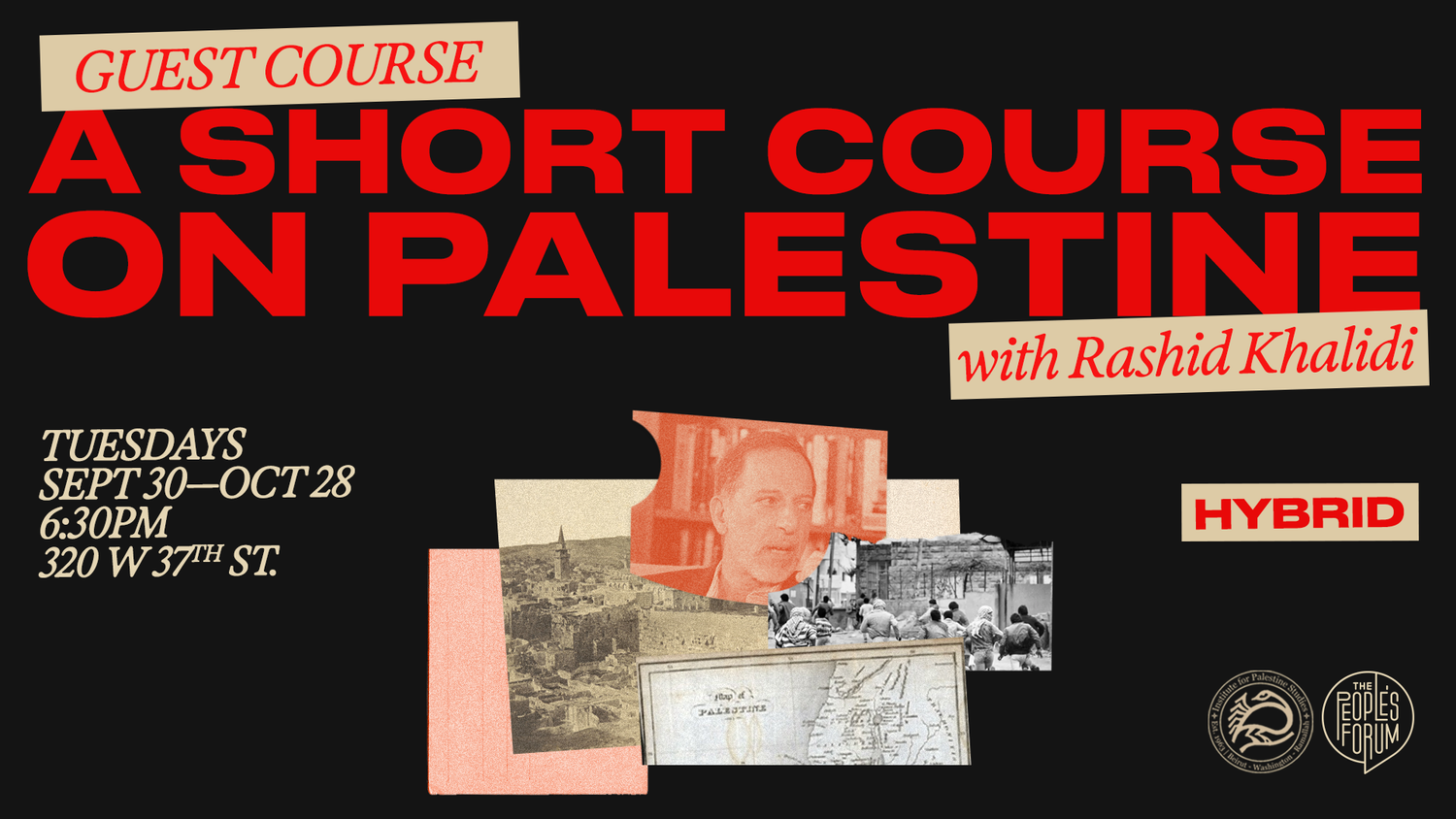
COMMUNITY EVENT | A Short Course on Palestine w/ Rashid Khalidi at People's Forum

The following is a description of and information about a course being taught in NYC by Rashid Khalidi. 

This class is not offered by Columbia University and is not available for course credit. 


“A Short Course on Palestine”

At the People’s Forum in NYC
Tuesdays, September 30-October 28, 6:30 PM – 8:30 PM
*In person and live-streamed*

“A course on modern Middle Eastern history was originally scheduled to be taught at Columbia University in Fall 2025. However, as Columbia continues its complicity in covering up the U.S.-Israeli genocide against Palestine and capitulates to the Trump administration at the expense of academic freedom and student rights, Professor Rashid Khalidi found it impossible to teach his course. This segment of the course, entitled A Short Course on Palestine, will now be offered at The People’s Forum, co-sponsored with the Institute for Palestine Studies, making it accessible to the broader public.” 

COURSE DESCRIPTION

This course examines the history of Palestine since 1917 in summary form. It starts from the premise that this is not a “conflict” between two equally matched parties, or that it started with the wars of 1948 or 1967. Rather, these episodes are part of a systematic, if intermittent, war that has lasted for over a century, aimed at dispossessing the Palestinian people and transforming their homeland into an exclusive Jewish national home. This war had its origins in several phenomena: the irruption of imperialism into the Middle East; the rise of nation-state nationalisms, both Arab and Jewish; the settler-colonial methods employed by the Zionist movement to “transform Palestine into the land of Israel” in the words of an early Zionist leader; and stubborn Palestinian resistance to these settler colonial aims and methods.

Emerging in response to virulent European anti-Semitism, the Zionist movement was, and initially saw itself as, both a nationalist and a settler-colonial project. After searching for other sponsors, in 1917 this movement garnered the support of the British Empire, which considered it to be a tool to achieve its strategic aims in the Middle East, and as a “little loyal Jewish Ulster in a sea of potentially hostile Arabism,” in the words of one British colonial official. Zionism thereby obtained the wherewithal for launching an externally supported war on Palestine and its people. Since then, the offspring of this movement, the state of Israel, has enjoyed the uninterrupted backing of major global powers, most importantly the United States. These powers saw Israel as serving their regional objectives, and have played crucial roles in supporting all of Israel’s wars since 1948.

WHEN

The course meets on Tuesdays from September 30 to October 28, from  6:30 – 8:30 PM ET, and will be held in-person at The People’s Forum in NYC (320 W 37th St.) and will be livestreamed via YouTube for those who cannot attend in-person.

DONATE TO UNIVERSITIES IN GAZA

All revenue from book sales related to this course, and all contributions by in-person and online participants, will go through a registered 501(C)3 to ISNAD, which supports the three main universities in the Gaza Strip.

READ | Remembering Brinkley Messick, 1946-2025


Professor Brinkley Messick in his office in the Department of Anthropology at Columbia University.


The Center for Palestine Studies mourns the passing of founding member and former Co-Director, Brinkley Messick.

Brinkley Morris Messick III, Professor Emeritus of Anthropology and Middle Eastern, South Asian, and African Studies (MESAAS) at Columbia University, passed away on August 14, 2025. Professor Messick was renowned for his innovative approach to fieldwork in the Middle East and North Africa, his elaboration of the concept of the anthropologist as reader, his groundbreaking scholarship on Islamic law, his steadfast commitment to the Palestinian cause, and his dedicated mentorship of graduate and undergraduate students.

Born in Dayton, Ohio in 1946 to Katherine Dart Messick and Brinkley Morris Messick II, Messick grew up in the Oakwood neighborhood and attended Andover Preparatory School. He earned his BA in Economics from the University of Pennsylvania in 1969, his MA in Anthropology and Near East Studies from Princeton in 1974, and his Ph.D. in Anthropology from Princeton University in 1978. He also served in the Peace Corps in Morocco.

Fluent in Arabic, including Classical Arabic and Maghrebi and Yemeni dialects, Messick specialized in interpreting historical legal texts. His work analyzed the production, circulation, inscription and subsequent interpretation of Arabic texts, including regional histories, law books, and court records. He archived the records from Yemen as a living legal tradition, and sought to understand the relation of writing and authority, such as the local histories of record keeping. His years living in Ibb, Yemen, where he cultivated lifelong relationships, informed his scholarship on Islamic legal texts, written culture, and legal anthropology. His seminal works, including The Calligraphic State: Textual Domination and History in a Muslim Society (1993), which won the Albert Hourani Prize, Islamic Legal Interpretation (co-edited, 1996), and Shariʿa Scripts: A Historical Anthropology (2018), established him as a leading authority on these topics; one who bridged the disciplines of anthropology and history. From 1993 to 1995, he received a Fulbright (CIES) grant, and in 1995, he was awarded the John Simon Guggenheim Memorial Foundation Fellowship.

Messick was an Associate Professor of Anthropology at the University of Michigan from 1993 to 1997, and joined Columbia University’s Anthropology Department in 1997. There, he collaborated with scholars like Lila Abu-Lughod, Rashid Khalidi and Mahmood Mamdani. Inspired by the work of Edward W. Said, Messick supported the Boycott, Divestment, Sanctions (BDS) movement to address Palestinian injustice. In 2010, he co-founded the Center for Palestine Studies at Columbia University to create an academic home for students and scholars interested in Palestine. Messick served as Co-Director of the Center from 2010-2015.


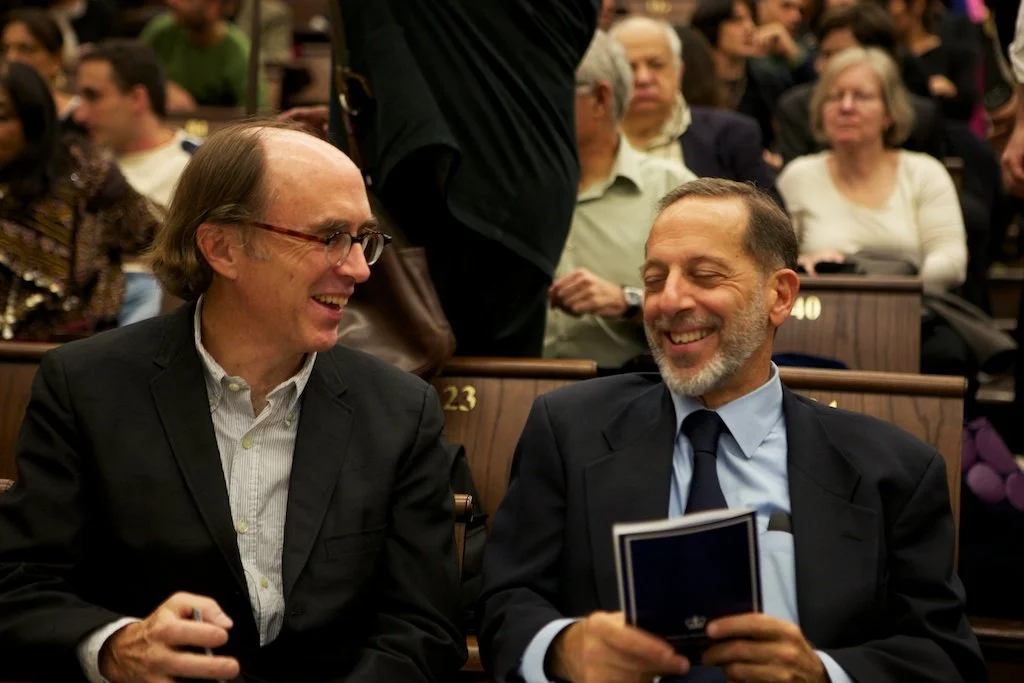
Professors Brinkley Messick and Rashid Khalidi at the Center for Palestine Studies inaugural event at Columbia University on October 7, 2010.


Messick also served as Director of the Middle East Institute at Columbia from 2015-2024. As Chair of the Anthropology Department at Columbia from 2004 to 2011, he demonstrated exceptional leadership, collegiality, and positivity. He promoted interdisciplinary initiatives and collaboration between faculty members and the administration.

Messick’s research and teaching extended to his abiding passions of photography and woven textiles. In addition, at the time of his passing, he was working on a book about questions of truth, method, and evidence. His legacy endures through his scholarship, his advocacy for Palestine, and his impact on Columbia University.

Messick is survived by his children, Robert Tyler Messick, Hayley Seeley Coupon, and Brigitte Eva Seeley-Messick, and by his brother, Joseph Dart Messick (Janet Kennedy Messick). Donations in his memory can be made to the Center for Palestine Studies at Columbia University. Details regarding a memorial service will follow.


CPS Core Faculty Members Brian Boyd, Rashid Khalidi, Brinkley Messick and Lila Abu-Lughod at a Center for Palestine Studies gathering on September 15, 2022.