
ATTEND | Palestine from Above – Surveillance, Cartography, Control

3 JUNE 2021
6pm LONDON

Join The Mosaic Rooms for the third part of the symposium When I see the future… in the public programme of Heba Y. Amin‘s exhibition When I see the future, I close my eyes. 

View the event details on The Mosaic Room’s website.

Jerusalem Quarterly guest editors Yazid Anani, Salim Tamari and select contributors Ariel Caine, Zeynep Çelik and Michael Talbot share this round table discussion dedicated to aerial surveillance of Palestine. The event marks Jerusalem Quarterly‘s special issue Palestine from Above: Surveillance Cartography and Control (Spring and Summer, 2020).

Jerusalem Quarterly is the leading journal on the past, present, and future of Jerusalem. It documents the current status of the city and its predicament. It is also dedicated to publishing new lines of inquiry by emerging scholars on Palestinian society and culture.

About the speakers

Yazid Anani born 1975, Ramallah, is the Director of the Public Programme at the A. M. Qattan Foundation, Ramallah. He curated and co-curated several projects including: Outside the Archive, Subcontracted nations, Zalet Lisan, The Facility, Weed Control and the 2nd- 6th editions of Cities Exhibition. More about Yazid Anani.

Ariel Caine is an artist and researcher currently living in London. He holds a PhD from the Centre for Research Architecture, Goldsmiths University and is a researcher at Forensic Architecture. More about Ariel Caine

Michael Talbot is Senior Lecturer in the History of the Ottoman Empire and Modern Middle East at the University of Greenwich. His research to date has examined Ottoman-British relations (17th-19th centuries), Ottoman maritime law and practice (18th century), and the history of late Ottoman Palestine. More about Michael Talbot.

Zeynep Çelik is distinguished professor emerita at the New Jersey Institute of Technology and adjunct professor of History at Columbia University. Her publications include Urban Forms and Colonial Confrontations (1997), Camera Ottomana (2014, co-editor), and Europe Knows Nothing about the Orient (forthcoming). More about Zeynep Çelik.

Salim Tamari is IPS senior fellow and the former director of the IPS-affiliated Institute of Jerusalem Studies. He is editor of Jerusalem Quarterly and Hawliyyat al Quds. He is professor of sociology at Birzeit University and an adjunct professor at the Center for Contemporary Arab Studies at Georgetown University. More about Salim Tamari.

Image: (Detail) Graf Zeppelin over Jerusalem, 1931. G. Eric and Edith Matson Photograph Collection, Library of Congress.
ATTEND | Said's Palestine, 1 June 2021 at 12:00 PM PST

"Said's Palestine" will engage in an analysis and discussion of contemporary conditions in Palestine through the terms of analysis Edward Said's corpus of work offers us. The discussion will range over what Said's terms enable in analysis and comprehension of the immediate and longer term causes, their limits in accounting for these conditions, and how to think about possible futures.

On Tuesday, June 1 at 12:00 PM PST, University of California Humanities Research Institute will host a conversation on Said's Palestine with Nadia Abu El-Haj (Barnard College and Columbia University), Esmat Elhalaby (UC Davis), Saree Makdisi (UC Los Angeles), Nadera Shalhoub-Kervorkian (Hebrew University), and Judith Butler (UC Berkeley).

Please RSVP to receive a personalized link to join the Zoom webinar.

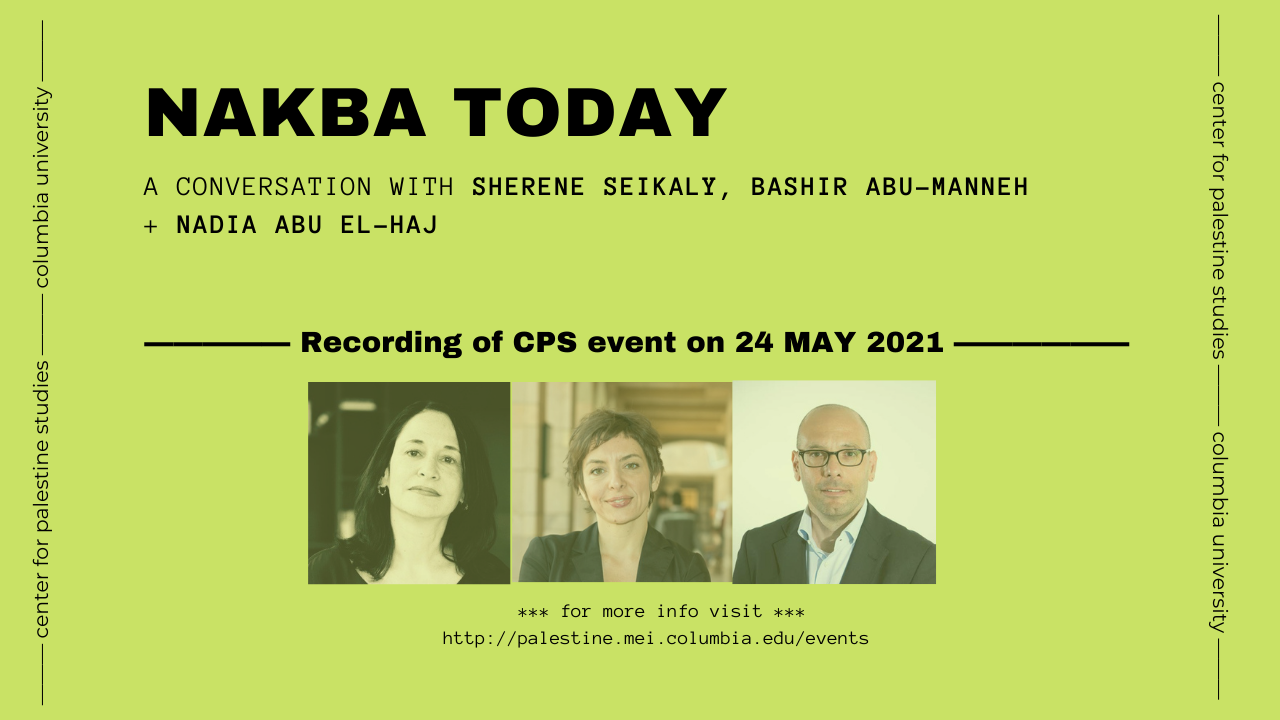
WATCH | Recording of NAKBA TODAY event with S. Seikaly, B. Abu-Manneh + N. Abu El-Haj

If you missed our conversation with Sherene Seikaly, Bashir Abu-Manneh and Nadia Abu El-Haj about recent events in the ongoing Nabka you can watch the recording now on the Center’s YouTube Channel.


Bashir Abu-Manneh is Head of School of English and Reader in Postcolonial Literature at University of Kent. He is author of The Palestinian Novel: From 1948 to the Present (2016) and Fiction of the New Statesman, 1913-1939 (2011), and is editor of After Said: Postcolonial Literary Studies in the Twenty-First Century (2018).

Sherene Seikaly is Associate Professor of History at the University of California, Santa Barbara. She is the author of Men of Capital: Scarcity and Economy in Mandate Palestine (2016). Seikaly is following her great-grandfather in her forthcoming book titled From Baltimore to Beirut: On the Question of Palestine. His trajectory from nineteenth century mobility across Baltimore and Sudan to twentieth century immobility in Lebanon places the question of Palestine in a global history of race, capital, slavery, and dispossession. She is co-editor of Journal of Palestine Studies, senior editor and co-editor of Jadaliyya.

Nadia Abu El-Haj is the Ann Olin Whitney Professor in the Departments of Anthropology at Barnard College and Columbia University, and Co-Director of the Center for Palestine Studies at Columbia. Abu El-Haj has published two books: Facts on the Ground: Archaeological Practice and Territorial Self-Fashioning in Israeli Society (2001) and The Genealogical Science: The Search for Jewish Origins and the Politics of Epistemology (2012). While Abu El-Haj’s two books to date have focused on historical sciences (archaeology, and genetic history), her third book, tentatively titled, Soldier Trauma, The Obligations of Citizenship, and the Forever Wars (Verso, forthcoming) examines the field of (military) psychiatry, and explores the complex ethical and political implications of shifting psychiatric and public understandings of the trauma of American soldiers.

READ | Statement in Solidarity with Palestine by Cultural Organizations, Artists and Writers

“As we watch the continuing destruction and devastation occurring in Palestine, we cannot stand by in silence. We urge you to consider the values we cherish and how we can translate them into meaningful action.

The disproportionate violence that Israel is currently waging on Palestinians in Gaza, the West Bank, and Israel is indiscriminate, inhumane, and illegal. Israel is a nuclear superpower, with the fifth largest military in the world. Palestinians are a stateless, almost entirely unarmed, civilian population. We thus refuse to describe this situation as a ‘conflict’ between ‘two sides’, a language which obscures the grossly unequal death toll, destruction, and devastation that Palestinians are inevitably forced to endure. 

We also call on you to take note of Human Rights Watch’s recent report which concluded that Israeli authorities “have dispossessed, confined, forcibly separated, and subjugated Palestinians by virtue of their identity to varying degrees of intensity”, such conduct amounting to crimes against humanity of apartheid and persecution.

As cultural institutions, we are deeply disturbed by the violent targeting of our Palestinian partners and colleagues who are critical of Israeli oppression and by the destruction of Palestinian schools in Gaza and the ransacking of cultural spaces, including the Dar Yusuf Nasri Jacir for Art and Research in Bethlehem. Wala’ Sbeit, a musician, was beaten and put under house arrest in Haifa for taking part in a demonstration; Mohammad El-Kurd, a poet and resident of Sheikh Jarrah, detained for no other reason than speaking publicly against Israeli threats to his family home.

We also note the power of language, its ability to gloss over state-sanctioned violence, and its role in normalizing occupation, institutionalizing colonialism, and erasing history. A case in point is the use of ‘evictions’ in reference to the removal of Palestinian families from Sheikh Jarrah in occupied East Jerusalem and how it deliberately misdirects from the reality of the Israeli occupation and the illegal displacement and dispossession of Palestinians from their homes. 

As we have stood in solidarity with the protests for black lives over the past year, as we have called for the decolonisation of our institutions, we must surely now extend our struggle against racism and colonialism to the defense of the Palestinians. It is morally incumbent upon us as artists and cultural workers to do so.”

Read the full statement and see the list of signatories on the website of The Mosaic Rooms, here.

READ | Statement by Gender Studies Departments in Solidarity with Palestinian Feminist Collective

Gender Studies Departments In Solidarity With Palestinian Feminist Collective

We stand in solidarity with the people of Palestine. We unequivocally answer and amplify the call from the Palestinian Feminist Collective for “feminists everywhere to speak up, organize, and join the struggle for Palestinian liberation.” We condemn the forced removal of Palestinians from their homes in Sheikh Jarrah, the raiding of the al-Aqsa mosque, the indiscriminate bombing of Gaza, one of the world’s most densely populated areas, and the de facto annexation of East Jerusalem, which by international law is illegally occupied territory. Israeli settlers, with the support of Israeli police and military forces, are taking over streets, invading homes, and brutalizing Palestinians. This right wing, ethnonationalist violence is often accompanied with the vile chant "Death to Arabs." We do not subscribe to a “both sides” rhetoric that erases the military, economic, media, and global power that Israel has over Palestine. This is not a “conflict” that is too “controversial and complex” to assess. Israel is using violent force, punitive bureaucracy, and the legal system to expel Palestinians from their rightful homes and to remove Palestinian people from their land. Israeli law systematically discriminates against Palestinian citizens of Israel. Illegal Israeli settlements choke and police Palestinian communities, and Palestinians are cut off from each other by a network of checkpoints, laws, settler-only highways, and a separation wall that swallows illegally occupied Palestinian land. Both Human Rights Watch and B’Tselem have concluded that Israeli policies and practices towards Palestinians amount to apartheid.

As gender studies departments in the United States, we are the proud benefactors of decades of feminist anti-racist, and anti-colonial activism that informs the foundation of our interdiscipline. In 2015 the National Women’s Studies Association wrote that our work is “committed to an inclusive feminist vision that is in solidarity with Indigenous peoples and sovereignty rights globally, that challenges settler colonial practices, and that contests violations of civil rights and international human rights law, military occupation and militarization, including the criminalization of the U.S. borders, and myriad forms of dispossession.” We center global social justice in our intersectional teaching, scholarship, and organizing. From Angela Davis we understand that justice is indivisible; we learn this lesson time and again from Black, Indigenous, Arab, and most crucially, Palestinian feminists, who know that “Palestine is a Feminist Issue.” In solidarity, we call for the end of Israel's military occupation of Palestine and for the Palestinian right to return to their homes. As residents, educators, and feminists who are also against the settler colonialism of the U.S., we refuse to normalize or accept the United States’ financial, military, diplomatic and political role in Palestinian dispossession. Furthermore, we will not tolerate any censorship of nor retribution against Palestinian scholars, activists, and those openly critical of the Israeli state. We join a vibrant, vast, and growing international solidarity community, composed of those raising their voices in support of Palestinian's right to freedom, return, safety, flourishing, and self-determination.

May 15th marked the 73rd anniversary of the Nakba, an ongoing ethnic cleansing of Palestine that drove over 750,000 Palestinians out of their homes, villages, and cities between the years 1947-1949. Today the vast majority of these Palestinians and their descendants are refugees in bordering countries and in the West Bank, Gaza, and East Jerusalem. Palestinians have been resisting settler colonialism for more than one hundred years. We hail the fortitude and determination of the Palestinian people, who remain, despite the fragmentation of their populations, united in their demands to end their oppression.

Visit http://genderstudiespalestinesolidarity.weebly.com for more information and to see the list of departments who signed the Solidarity Statement, including the Department of Women’s, Gender, and Sexuality Studies, Barnard College, Columbia University and the Institute for Research on Women, Gender, and Sexuality, Columbia University.

ATTEND | Teach-In: A Third Intifada? Palestinians and the Struggle for Jerusalem

Thursday, May 20, 2021
1:00 – 2:30 p.m.
Register to obtain your access link.
View the event page on The Center for Middle East Studies, Brown University website.

Are recent events yet another cycle of age-old ethnic and religious conflict over Jerusalem, or are we witnessing a third intifada by Palestinians against decades of systematic dispossession and displacement following the nakba of 1948? And how is the Palestinian condition relevant to global justice struggles against settler colonialism and racism?

The teach-in is organized by the Center for Middle East Studies and the New Directions in Palestinian Studies Initiative at Brown University; co-sponsored by the Center for the Study of Race and Ethnicity in America, the Center for the Study of Slavery and Justice, the Pembroke Center for Teaching and Research on Women, the Departments of Africana Studies, American Studies, History, and Religious Studies.

Moderator:
Nadje Al-Ali, Brown University

Introductory words by event cosponsors:
Tony Bogues, Brown University, Director, Center for the Study of Slavery & Justice
Brian Meeks, Brown University, Chair, Africana Studies

Speakers include:
Rana Barakat, Birzeit University
Beshara Doumani, Brown University
Aya Ghanameh, RISD
Weeam Hammoudeh, Birzeit University
Adrienne Keene, Brown University
Adi Ophir, Brown University

ATTEND | Ongoing Nakba: Reflections on Palestine from Sheikh Jarrah to Gaza

Wednesday, May 19, 2021, 12:00pm CDT / 1:00pm EDT

Visit the event website for more info and to register.

The ongoing attempts to expel Palestinians from their homes in Sheikh Jarrah are not new, but they have brought fresh attention to the movement for Palestinian liberation worldwide and triggered mobilizations across Palestine unlike anything that has been seen in recent years. New and amplified mobilization across Palestine has created a variegated landscape of resistance connecting Palestinians on either side of the Green Line, in Gaza, and in exile, along with massive crowds of supporters and a surprising cast of liberal journalists and politicians.

Join us as we bring together panelists to discuss the latest developments and various mobilizations across Palestine.

Panelists:

  • Jehad Abusalim

  • Hadeel Badarni

  • Rabea Eghbariah

  • Lucy Garbett

  • Randa Wahbe

Moderated by Hadeel Assali

This event is free and open to the public: register here to join the Zoom webinar, or visit Jadaliyya’s Facebook page for the livestream. Please email us at ccct@uchicago.edu if you require any accommodations to enable your full participation.

Presented by 3CT, the Global Studies Program, the Pozen Family Center for Human Rights, the Center for Middle Eastern Studies, and the Arab Studies Institute.

WATCH | Rashid Khalidi in Conversation with Lana Tatour

A conversation between Rashid Khalidi and Lana Tatour about recent events and the historical context, laid out in Khalidi’s book, The Hundred Years’ War on Palestine (2020).