
A State of Passion: Ghassan Abu Sittah | Film Screening & Discussion
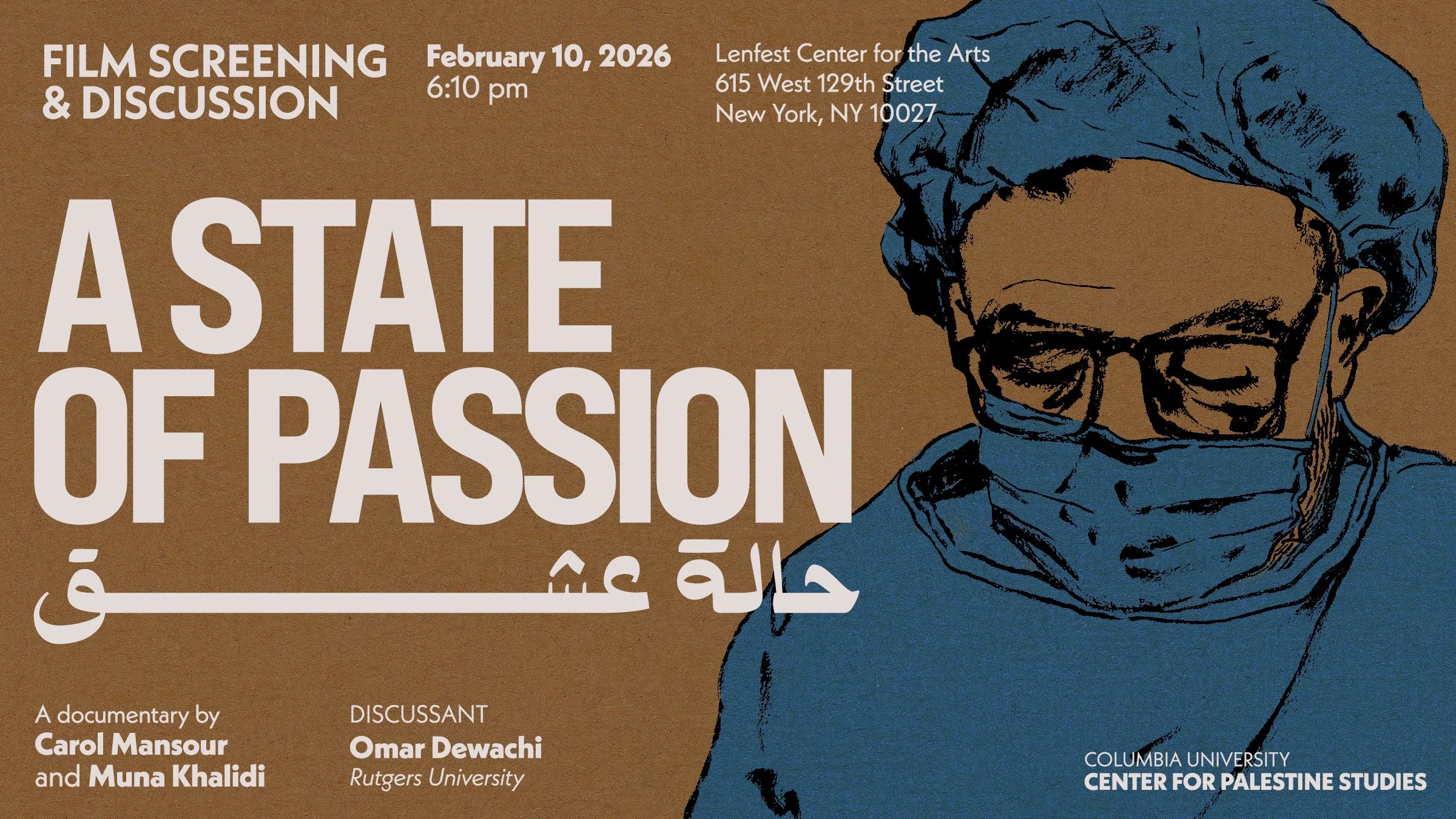
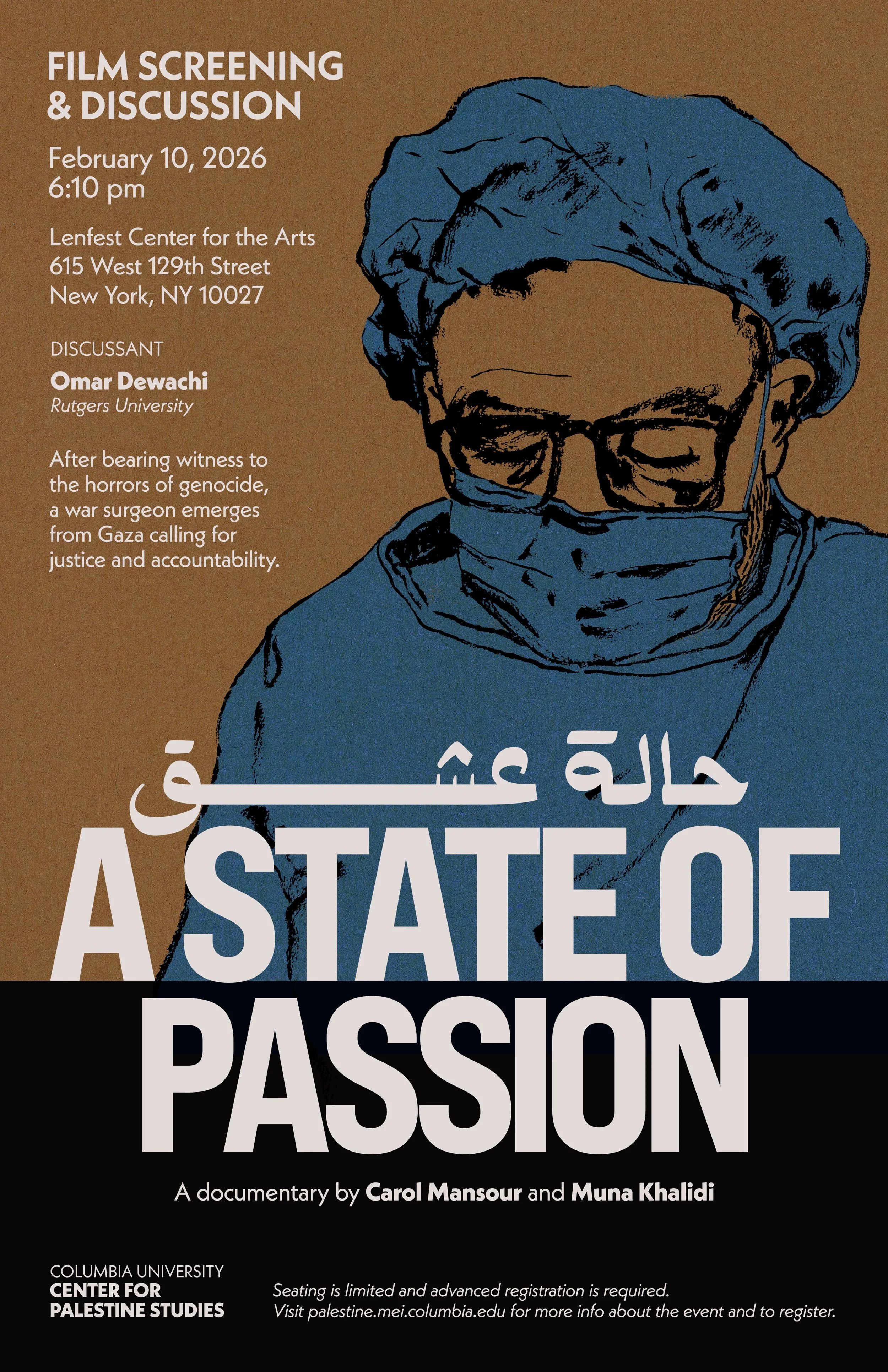
The Center for Palestine Studies presents a screening of A State of Passion: Ghassan Abu Sittah followed by a discussion with Omar Dewachi (Rutgers University).
Advance registration for this event has closed. Tickets may still be available at the door; an in-person stand-by line will form one hour before the event. There is no charge for tickets to this event.
VENUE
The Katharina Otto-Bernstein Screening Room
Lenfest Center for the Arts
615 West 129th Street
New York, NY 10027
After 43 horrific days working round the clock under constant bombardment in the emergency rooms of Gaza’s Al Shifa and Al Ahli hospitals, British-Palestinian reconstructive surgeon, Dr. Ghassan Abu Sittah, emerged to find himself as a face of Palestinian resistance.
With news footage of him pale and shell-shocked reverberating around the world, he spoke of a catalogue of horrors from lacerated bodies, to amputations without anesthetics, orphaned children with no surviving family, and the deliberate targeting of medics and hospital facilities.
This was Ghassan’s sixth and most horrific Gaza “war”. Why does he do it? Where does he find the strength to face it again and again? How does it impact his family? How do they process the risks he takes? The answer lies simply in their shared passion: Palestine, a passion they articulate through their support of his perilous humanitarian work.
Filmmakers Carol Mansour and Muna Khalidi, close friends of the Abu Sittahs, share that same passion. They were waiting anxiously for Ghassan to emerge from Gaza, following a long and terrifying journey through the night, to meet him in Amman. Determined to capture his raw emotions they began filming him the moment he arrived through the door. Following him to Beirut, Amman, London, Kuwait and Dubai, they and he explore their common State of Passion.
This film includes graphic footage of war, including torture, injury, surgery and views of dead bodies.
DISCUSSANT
Omar Dewachi is a physician-trained anthropologist whose work examines medicine, governance, and violence in the modern Middle East. Trained as a medical doctor in Iraq, he is currently Chair of the Department of Anthropology at Rutgers University, where his research and teaching bridge anthropology, the history of medicine, and critical global health to explore how care, expertise, and health systems are reshaped by war and political upheaval. His first book, Ungovernable Life, examines the rise and unraveling of state medicine in Iraq, tracing the entanglement of medical governance with colonialism, authoritarianism, sanctions, and war. His forthcoming book, Death of the Clinic: Chronicles of War Biology, explores how prolonged violence transforms biological life, injury, and the foundations of clinical practice. His writing has appeared in a wide range of venues, from The Lancet to interdisciplinary journals and public forums.
A central thread in Dewachi’s work is his long-standing collaboration with the Palestinian-British surgeon, academic, and activist Ghassan Abu Sittah, spanning more than a decade and a half, particularly in Beirut. Together, they co-founded and directed the Conflict Medicine Program at the American University of Beirut (2016-2018), developing a critical framework for war surgery, humanitarian ethics, and the political afterlives of injury. Most recently, The New York Times Magazine profiled Dewachi and the work he has carried out with Abu Sittah, highlighting their joint efforts to document and reflect on medicine and violence in contexts of war.